THE SUN IS STILL BLANK: For the 5th day in a row, the face of the sun is blank--no sunspots. As a result, solar activity is low. NOAA forecasters say the chance of a strong solar flare today is no more than 1%. Solar flare alerts: text or voice
WHAT'S AROUND THE BEND? The Earth-facing side of the sun is quiet, but the farside is not. We know because on Saturday something exploded there, hurling a cloud of plasma over the sun's eastern limb. NASA's Solar Dynamics Observatory recorded a movie of the high-flying debris:
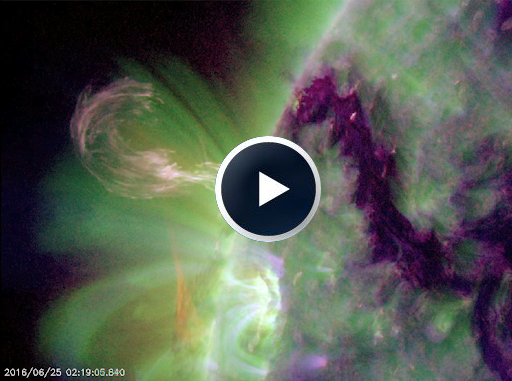
Within a few days, the underlying blast site should reveal itself as the sun's rotation brings the active region over the horizon. We shall see if it is a large sunspot or something less threatening.
Until then, the visible disk of the sun remains blank and the odds of an Earth-directed explosion are low. NOAA forecasters say there is no more than a 1% chance of strong solar flares on June 26th. Solar flare alerts: text or voice
Realtime Space Weather Photo Gallery
WHEN IS A RAINBOW NOT A RAINBOW? At this time of year, a colorful arc often appears in the noontime sky. It looks like a rainbow, but it's not. "I saw one on June 23rd while I was walking through forest near Flagstaff, Arizona," reports David Blanchard, who took this picture through the treetops:

Blanchard witnessed a circumhorizon arc--a rainbow-colored band of light caused by the sun shining through plate-shaped ice crystals floating in cirrus clouds. Actual rainbows, on the other hand, are caused by sunlight reflected from raindrops.
Summer is the season for circumhorizontal arcs because they appear only when the sun is high in the sky--more than 58o above the horizon. The arc's enormous size and pure spectral colors make it one of the most beautiful of all ice halos.
At medium latitudes, like much of the USA, the arc is not rare.Typically, it can be seen several times each summer. In contrast, further north in much of Europe the circumhorizon arc is a rarity and impossible to see north of Copenhagen. See the charts in Les Cowley's web page 'How rare?' for the visibility at your location.
Realtime Space Weather Photo Gallery
SCORPION WITH A MAGNETIC TAIL: As the face of the sun grows quiet, attention is turning to the edge of the sun. "The spotless sun put out a large, fast moving prominence today... a loop that rose and disappeared quickly," reports astrophotographer Alan Friedman of Buffalo, New York. "Frozen in time it looks a bit like a scorpion, no?"
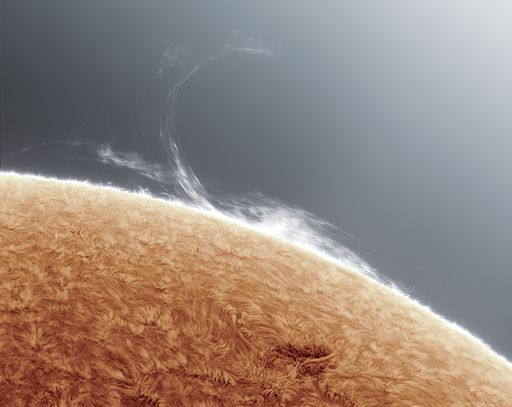
Prominences are filaments of magnetism filled with glowing-hot plasma. They attract attention when they grow large and hang out over the edge of the solar disk. The magnetic tail of this scorpion is more than 150,000 km long!
Even when sunspots vanish, magnetic filaments are known to criss-cross the solar disk. Sometimes they collapse and hit the stellar surface, igniting explosions called Hyder Flares. Readers should expect to see more of these structures as sunspots fade away. Solar Minimum is not boring ... only different. Stay tuned for "quiet."
Realtime Space Weather Photo Gallery
Realtime Noctilucent Cloud Photo Gallery