CLIMATE CHANGE AT THE EDGE OF SPACE: A hundred years ago, noctilucent clouds were an Arctic phenomenon. You had to travel to very high latitudes to see them. In recent years, however, the electric blue clouds have been sighted as far south as Colorado and Kansas. What's happening? A new study by researchers working with NASA's AIM spacecraft suggests an answer: It's climate change at the edge of space.
THE SUN LOOKS LIKE A BILLIARD BALL: The sun has now been without spots for 7 consecutive days. Our star looks like an enormous yellow billiard ball:
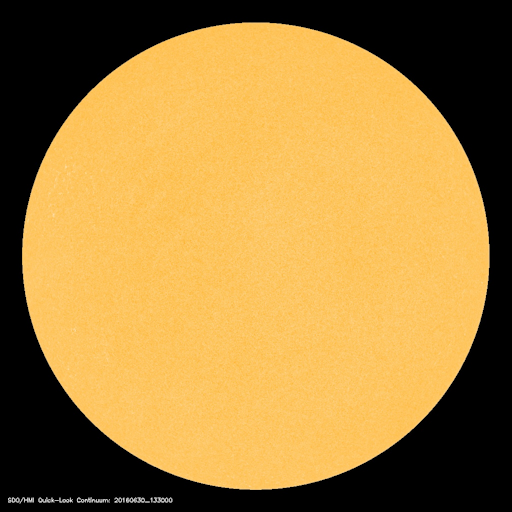
The last time sunspots vanished for a whole week was in Dec. 2010--a time when the sun was bouncing back from a long Solar Minimum. In this case, the 7 week interregnum is a sign that a new Solar Minimum is coming.
The sunspot cycle is like a pendulum, swinging back and forth every 11-years or so between times of high and low sunspot number. The next low is expected in 2019-2020. Between now and then sunspots will become increasingly rare with stretches of days, then weeks, then months of "billiard-ball suns."
Without sunspots, there will be fewer solar flares and CMEs. However, that doesn't mean space weather will stop. On the contrary, new forms of space weather will rise to the fore, including high doses of cosmic rays, more "space lightning" (sprites), altered states of ham radio propagation, and geomagnetic storms triggered by solar wind streams and co-rotating interaction regions instead of CMEs. Stay tuned for the next phase of the solar cycle. Solar flare alerts: text or voice
Realtime Space Weather Photo Gallery
BRIGHT AURORAS CAST SHADOWS: No sunspots? No problem. "Yesterday, June 28th, we observed auroras so bright they cast shadows on the ground," reports B. Sudarsan Patro of the Bharati Indian Base Station in Antarctica. He sends this picture from the Larsemann Hills at latitude 69°S:

"It was very cold outside, but the sight of this amazing display gave us a feeling of warmth," says Patro.
On June 28th there were no sunspots, no solar flares, and no CMEs. Even without those forms of solar activity, the aurora australis appeared in force over the frozen continent. What caused the display? We don't know. Sometimes space weather just happens.
For more surprises, browse the realtime photo gallery:
GREEN FLASH ON THE RED PLANET: Occasionally, when the sun sets behind the waves of the ocean, observers witness an emerald pulse of light just above the vanishing solar disk. Once thought to be a fable, the "green flash" is now known to be real, and is a regular entry on bucket lists. The phenomenon, however, is not limited to the sun. Yesterday, Peter Rosén of Stockholm, Sweden, observed a type of green flash on Mars:
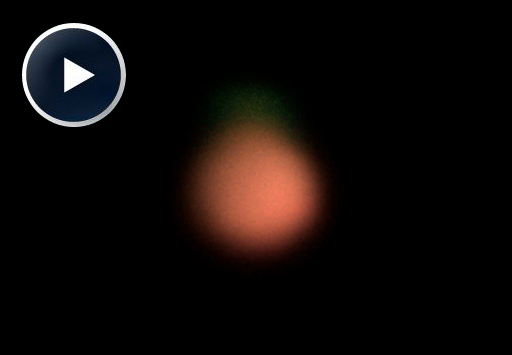
"I was observing Mars through my 9-inch Celestron telescope," says Rosén. "It was setting, only 3° above the horizon, and the atmospheric turbulence was extreme. Suddenly I saw the upper part of the planet getting distorted and turning green."
"It looked just like a green flash on the sun," he says.
The phenomenon Rosén photographed is related to the ordinary twinkling of stars. Near the horizon, blobs of turbulent air refract and distort light, some colors more so than others, separating red from green and blue. The puff of green rising from the martian disk is a result of this type of chromatic turbulence.
Green flashes on the sun happen for different, but related reasons: According to Les Cowley's atmospheric optics web site: "The classical green flash relies on a mirage to magnify small differences in refraction between red and green light. The mirage occurs when there is warm air immediately over the ocean and the air temperature gradient changes rapidly with height."
"I have observed and photographed solar green flashes on multiple occasions," says Rosén, "but this was the first time I caught a green flash on the red planet!"
Realtime Noctilucent Cloud Photo Gallery