CHANCE OF STORMS THIS WEEKEND: NOAA forecasters say there is a 55% chance of G1-class geomagnetic storms on July 2/3 when a CIR is expected to hit Earth's magnetic field. CIRs (co-rotating interaction regions) are transition zones between slow- and fast-moving streams of solar wind. Density gradients and shock waves in CIRs often spark polar auroras. Aurora alerts: text or voice

WHAT SUNSPOTS LEAVE BEHIND: With the sunspot number dropping to zero, the face of the sun is blank. Or is it? A closer look at the stellar surface reveals what the vanishing sunspots have left behind: solar granulation. Bernard Durand sends this picture from the French Alps:

What are these granules? The sun is so hot, it literally boils. Granules are bumps on the boiling surface, much like the bumpy surface of water boiling on a hot stove. One difference: While the granules on your stove are only a few centimeters across, granules on the sun are as wide as Texas. If you have a solar telescope, take a look.

:Realtime Space Weather Photo Gallery
NIGHT LIFE IN ANTARCTICA: You'd think extreme cold in the dead of winter would keep Antarctic researchers inside. The staff of the Bharati Indian Base Station in Antarctica's Larsemann hills are an exception: "We can't stay inside," reports B. Sudarsan Patro. "The night life is just too amazing!"

Patro took this group self portrait on June 30th during a brilliant outburst of auroras. "They were so bright," he says, "the snow turned green. The sparkling display reminded us of Diwali, the Hindu festival of lights." Spiritually, Diwali signifies the victory of light over darkness--very appropriate for a midwinter display of aurora australis.
This display shows that bright auroras can occur even when solar activity is very low. There were no sunspots, no solar flares, and no CMEs on June 30th, yet skies turned green anyway. Probably what happened is this: Earth passed through a region of space filled with negative-polarity magnetic fields (known to researchers as "negative B sub z"). Such fields can open a crack in Earth's magnetosphere. Solar wind pours in and sparks bright auroras--no sunspots required.
NOCTILUCENT CLOUDS: In the northern hemisphere, July is usually the best month for noctilucent clouds (NLCs). The electric-blue ripples are bright and widespread, sometimes sighted as far south as Colorado and Kansas. Right on cue, July 1st brought a magnificant display. Ruslan Merzlyakov sends this picture from Nykøbing Mors, Denmark:

"We witnessed an absolutely amazing apparition of noctilucent clouds in the first hours of July 1st," says Merzlyakov. "The whole horizon from west to east was filled with silver light and it was very bright!"
"I recorded short a video to give you a sense of what it looked like in real time," he adds. Play it!
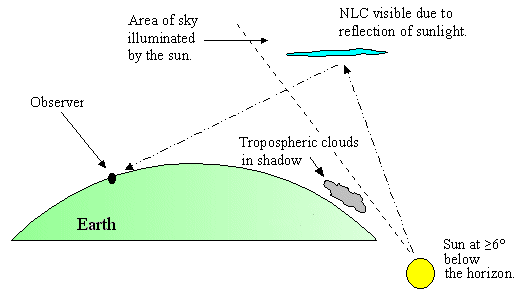
NLCs are Earth's highest clouds. They float more than 80km above Earth's surface where diaphanous wisps of water vapor from the planet below wrap themselves around the ashy remains of meteoroids. The resulting ice crystals glow electric blue in the night sky when they are illuminated by sunlight at the edge of space. There is growing evidence that NLCs are spreading as a result of climate change.
Ready to see for yourself? Observing tips: Look west 30 to 60 minutes after sunset when the sun has dipped ~10 degrees below the horizon. If you see luminous blue-white tendrils spreading across the sky, you may have spotted a noctilucent cloud.
Realtime Noctilucent Cloud Photo Gallery