THE MOST POWERFUL AURORAS IN THE SOLAR SYSTEM: Armored like a tank to protect it from intense radiation, NASA's Juno spacecraft entered orbit around Jupiter on July 4th. The behemoth spacecraft is on a mission to discover what lies beneath the giant planet's towering clouds. Bonus: In the months ahead, Juno will fly over Jupiter's poles for a point-blank view of the most powerful auroras in the solar system. Unlike Earth, which lights up in response to solar activity, Jupiter makes its own auroras in part from the gaseous exhaust of Io's volcanoes. Get the full story from Dr. Tony Phillips. Aurora alerts: text or voice
MAGNETIC CANYON ON THE SUN: A canyon-shaped hole has opened up in the sun's atmosphere, and it is spewing solar wind into space. NASA's Solar Dynamics Observatory is monitoring the structure, which stretches more than 700,000 km from end to end:

This is called a "coronal hole." Coronal holes are places in the sun's atmosphere where magnetic fields peel back and allow hot gas to escape. A gaseous stream of solar wind flowing from this opening will reach Earth on July 8th or 9th, possibly sparking polar geomagnetic storms when it arrives. High-latitude sky watchers should be alert for auroras, especially in the southern hemisphere where dark winter skies favor visibility. Aurora alerts: text or voice
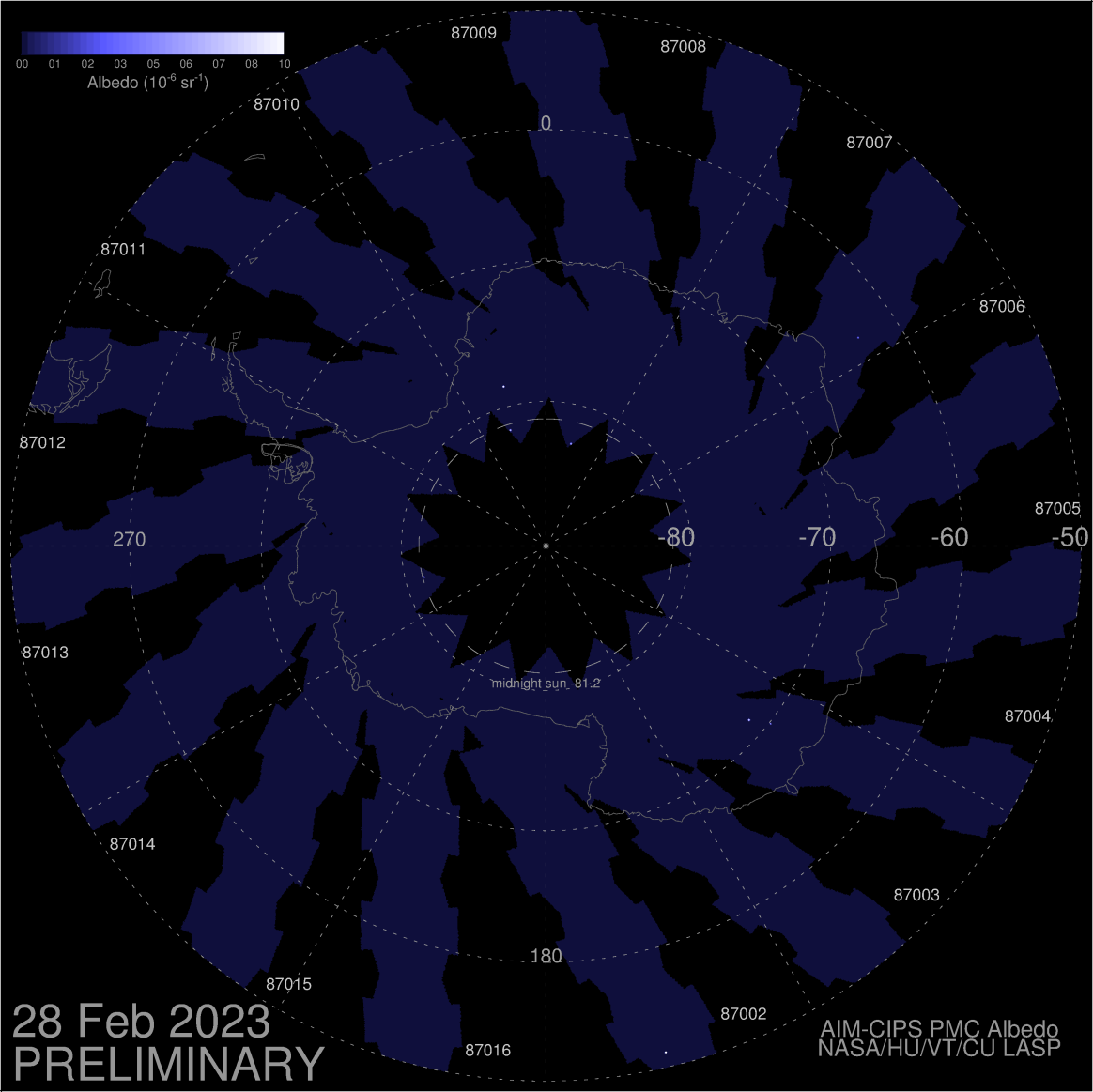
AURORAS AND NOCTILUCENT CLOUDS: Who needs sunspots? Despite a lull in solar activity, July began with a beautiful display of color over Calgary, Alberta. Harlan Thomas photographed the sudden apparition of green auroras and silver noctilucent clouds:

"On the evening of June 30th, I faithfully checked the Spaceweather.com AIM daisy and saw that noctilucent clouds were forming over North America," says Thomas. "So I drove my Jeep to a dark location outside Calgary--and promptly fell asleep."
"About 30 minutes after midnight on July 1st something woke me up," he adds. "The noctilucent clouds had appeared, and they were not alone. I was surprised to see some green auroras as well."
Indeed, the auroras were a surprise. There were no sunspots, no solar flares, and no CMEs on June 30th, yet skies turned green anyway. Here's what happened: Earth passed through a region of space filled with negative-polarity magnetic fields (known to researchers as "negative B sub z"). Such fields can open a crack in Earth's magnetosphere. Solar wind pours in and sparks auroras--no sunspots required.
At the same time, an even brighter display of auroras appeared over Antarctica. Browse the gallery for more sightings:
Realtime Noctilucent Cloud Photo Gallery
ASTROARTS AT THE EDGE OF SPACE: Approximately once a week, Spaceweather.com and the students of Earth to Sky Calculus launch helium balloons to the stratosphere. Their purpose is to monitor cosmic rays, which are intensifying as the solar cycle crashes. All that helium costs money, and our research flights depend on sponsors such as AstroArts--shown here at the edge of space on June 29th:

AstroArts' generous donation of $500 not only propelled their 25th anniversary display to the edge of space, but also added another crucial data point to the growing record of atmospheric radiation. Thank you, AstroArts!
Readers, if you would like to send an item of your own to the top of Earth's atmosphere, you can book a flight with as little as two week's notice. Contact Dr. Tony Phillips to become a sponsor!
Realtime Space Weather Photo Gallery