THE SUNSPOTS ARE BACK: Two tiny sunspots have appeared, breaking a 12-day string of spotless suns. Nevertheless, solar activity remains very low. NOAA forecasters say there is no more than a 1% chance of solar flares on July 6th. Solar flare alerts: text or voice
NOCTILUCENT CLOUDS DESCEND TO MID-LATITUDES: Noctilucent clouds in France are rare. Yet photographer Lericque Simon has seen them two nights in a row. He captured these electric-blue waves rippling over Wancourt, a small town in Pas-de-Calais, on July 6th:

"Yesterday, I asked for more noctilucent clouds, and today I was rewarded!" says Simon. "The NLCs this morning were much larger and brighter than the day before with spectacular waves."
Observers saw them in other European countries, too: Sweden, England, Germany, the Netherlands, Denmark, Poland, Hungary and Romania. The sighting in Romania is significant because of its latitude--only 46 degrees. This means the clouds have spread south to mid-latitudes.
"It was my first time seeing noctilucent clouds in real life," says Stefan Leahu of Cluj, Romania. "What a wonderful display!"
When noctilucent clouds first appeared in the 19th century, you had to travel to near-Arctic latitudes to see them. In recent years, however, they have intensified and spread with sightings as far south as Colorado and Kansas. There is mounting evidence that this is a result of climate change.
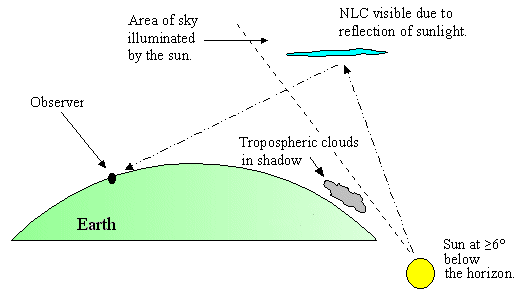
The frequency of sightings in Europe suggests that electric blue ripples could soon appear over the USA. Observing tips: Look west 30 to 60 minutes after sunset when the sun has dipped ~10 degrees below the horizon. If you see luminous blue-white tendrils spreading across the sky, you may have spotted a noctilucent cloud.
Realtime Noctilucent Cloud Photo Gallery
MAGNETIC CANYON ON THE SUN: A canyon-shaped hole in the sun's atmosphere is spewing solar wind into space. The structure stretches more than 700,000 km from end to end, as shown in this extreme ultraviolet image from NASA's Solar Dynamics Observatory:

This is called a "coronal hole," a place in the sun's atmosphere where magnetic fields peel back and allow hot gas to escape. Coronal holes are not unusual; they appear on the sun several times a month. This one, however, is much larger than most.
Update: NOAA forecasters say that solar wind flowing from this coronal hole could reach Earth as early as July 7th, with a 50% chance of G1-class geomagnetic storms when it arrives. High-latitude sky watchers should be alert for auroras, especially in the southern hemisphere where dark winter skies favor visibility. Aurora alerts: text or voice

ASTROARTS AT THE EDGE OF SPACE: Approximately once a week, Spaceweather.com and the students of Earth to Sky Calculus launch helium balloons to the stratosphere. Their purpose is to monitor cosmic rays, which are intensifying as the solar cycle crashes. All that helium costs money, and our research flights depend on sponsors such as AstroArts--shown here at the edge of space on June 29th:

AstroArts' generous donation of $500 not only propelled their 25th anniversary display to the edge of space, but also added another crucial data point to the growing record of atmospheric radiation. Thank you, AstroArts!
Readers, if you would like to send an item of your own to the top of Earth's atmosphere, you can book a flight with as little as two week's notice. Contact Dr. Tony Phillips to become a sponsor!
Realtime Space Weather Photo Gallery