MAGNETIC STORM IN PROGRESS: A minor G1-class geomagnetic storms is in progress on July 7th as Earth enters a stream of fast-moving solar wind. High-latitude sky watchers should be alert for auroras, especially in the southern hemisphere where dark winter skies favor visibility. Aurora alerts: text or voice

METEOR SMOKE MAKES STRANGE CLOUDS: Have you ever looked at a noctilucent cloud (NLC) and thought ... that looks alien? In fact, it is. A key ingredient of NLCs comes from outer space. The electric-blue clouds form when wisps of summertime water vapor rise up from Earth and wrap themselves around meteor smoke in the upper atmosphere. For the past few nights, NLCs have been shimmering brightly over much of Europe. Mark Savage photographed this apparition on July 6th from Newcastle Upon Tyne, England:

"The clouds grew more extensive as the night progressed," says Savage. "Just before sunrise, they stretched further eastwards than I've ever seen."
Observers saw them in other European countries, too: France, Sweden, Finland, Germany, the Netherlands, Denmark, Poland, Hungary, Latvia, and Romania. The sighting in Romania is significant because of its latitude--only 46 degrees. This means the clouds have spread south to mid-latitudes.
"It was my first time seeing noctilucent clouds in real life," says Stefan Leahu of Cluj, Romania. "What a wonderful display!"
When noctilucent clouds first appeared in the 19th century, you had to travel near Arctic latitudes to see them. In recent years, however, they have intensified and spread with sightings as far south as Colorado and Kansas. There is mounting evidence that this is a result of climate change.
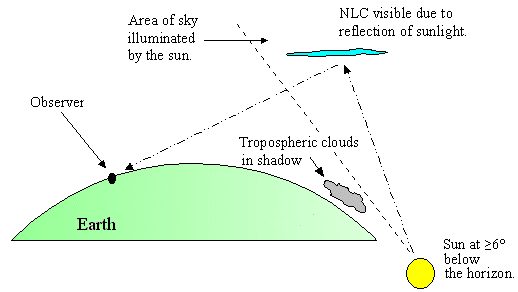
The frequency of sightings in Europe suggests that electric blue ripples could soon appear over the USA. Observing tips: Look west 30 to 60 minutes after sunset when the sun has dipped ~10 degrees below the horizon. If you see luminous blue-white tendrils spreading across the sky, you may have spotted a noctilucent cloud.
Realtime Noctilucent Cloud Photo Gallery
A DRONE IN THE STRATOSPHERE: Spaceweather.com and the students of Earth to Sky Calculus recently flew a toy drone all the way to the stratosphere. Here it is en route to the edge of space above the White Mountains of central California on June 29th:

How did it get there? Small drones can't fly in the thin air 100,000 feet above Earth's surface; their tiny propellers don't generate enough lift.
Mystery solved: This unpowered drone was carried aloft by a helium balloon. Here it is moments before launch:

The black rectangle just above the drone is a Richo Theta S spherical camera. It's the device that photographed the drone in flight and removed the thin black rope from the scene. The fully-interactive spherical image is fun to explore!
We flew this drone as a promotion for World Tech Toys, who generously sponsored our cosmic ray payload, also shown in the picture above. It's the red capsule underneath the balloon. This flight and others like them are not only fun, but also they contribute to a crucial record of intensifying cosmic rays in the stratosphere.
Readers, if you would like to send an item of your own to the top of Earth's atmosphere, you can book a flight with as little as two week's notice. Contact Dr. Tony Phillips to become a sponsor!
Realtime Space Weather Photo Gallery