SUNSET SKY SHOW: When the sun goes down tonight, step outside and look west. Jupiter and the crescent Moon are side-by-side in the sunset sky. If possible, try to catch them before the sky fades to black. There is a special beauty to the sight of two bright heavenly bodies framed by twilight blue. [sky map]

SOUTHERN LIGHTS: A fast-moving stream of solar wind is buffeting Earth's magnetic field today. This is causing intermittent G1-class geomagnetic storms and auroras around the poles. Ian Griffin sends this picture from Hoopers Inlet, Otago Peninsula, New Zealand:

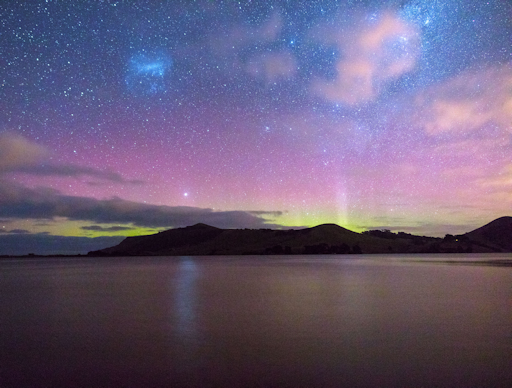
"A lovely display of the aurora australis made my evening here in Dunedin," says Griffin. "It was the perfect end to a day, which I spent touring the SOFIA Observatory, presently deployed in Christchurch!"
NOAA forecasters say there is a 50% chance of additional geomagnetic storms on July 8th, waning to 25% on July 9th as Earth begins to exit the solar wind stream. Auroras could appear over both poles. Dark winter skies favor visibility in the southern hemisphere. Aurora alerts: text or voice
RADIO BEAMS FROM JUPITER HIT EARTH: Yesterday, a series of narrow radio beams from Jupiter reached Earth ... but they weren't from NASA's Juno spacecraft. They came from Jupiter itself. Natural radio lasers in Jupiter's magnetosphere send shortwave signals into space and occasionally they sweep past Earth. "I picked them up in broad daylight," says Thomas Ashcraft, who operates an amateur radio telescope in rural New Mexico. Click on the image to hear the static-y sounds that emerged from his loudspeaker:
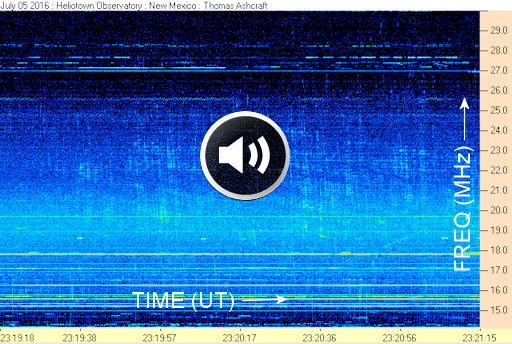
Each pop and click is the sound of a single beam washing over our planet. "The interesting thing to me," says Ashcraft, "is that unbeknownst to us Jupiter radio beams are often sweeping over us, actually washing over our bodies if we are outside at the time."
The lasers are powered, in part, by electrical currents flowing between Jupiter's upper atmosphere and the volcanic moon Io. When the geometry is just right, and Earth is in line with the beams, they are easily detected by ham radio antennas on Earth. Jovian "S-bursts" (short bursts) and "L-bursts" (long bursts) mimic the sounds of woodpeckers, whales, and waves crashing on the beach. Here are a few audio samples: S-bursts, S-bursts (slowed down 128:1), L-Bursts
Now is a good time to listen to Jupiter's radio storms. The giant planet is high in the sky at sunset and, thanks to the crashing solar cycle, background noise is low. There are few solar radio bursts to overwhelm Jupiter and terrestrial stations are having a hard time bouncing over the horizon as ionizing radiation from the sun ebbs. Ready to start taking data? NASA's Radio Jove Project explains how to build your own receiver.
A DRONE IN THE STRATOSPHERE: Spaceweather.com and the students of Earth to Sky Calculus recently flew a toy drone all the way to the stratosphere. Here it is en route to the edge of space above the White Mountains of central California on June 29th:
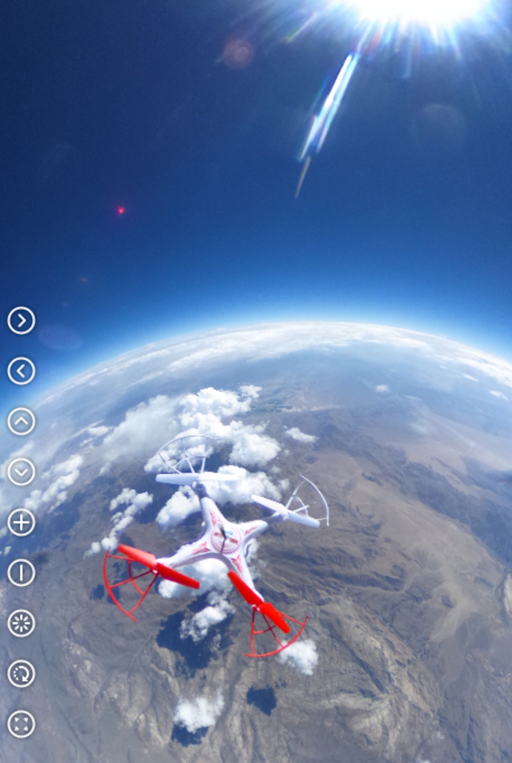
How did it get there? Small drones can't fly in the thin air 100,000 feet above Earth's surface; their tiny propellers don't generate enough lift.
Mystery solved: This unpowered drone was carried aloft by a helium balloon. Here it is moments before launch:
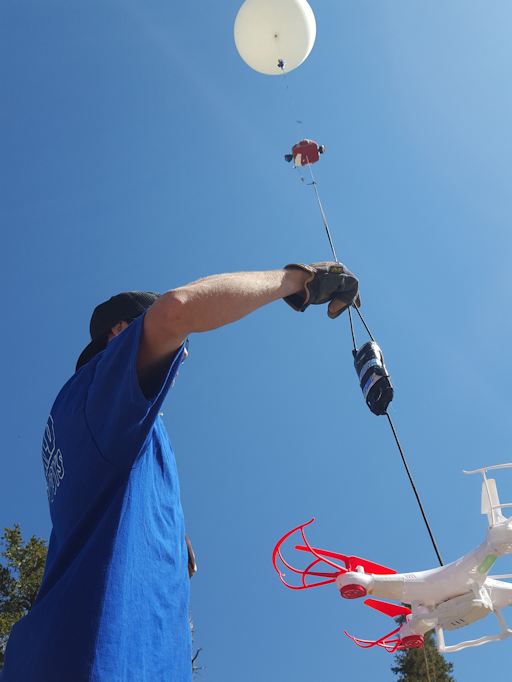
The black rectangle just above the drone is a Richo Theta S spherical camera. It's the device that photographed the drone in flight and removed the thin black rope from the scene. The fully-interactive spherical image is fun to explore!
We flew this drone as a promotion for World Tech Toys, who generously sponsored our cosmic ray payload, also shown in the picture above. It's the red capsule underneath the balloon. This flight and others like them are not only fun, but also they contribute to a crucial record of intensifying cosmic rays in the stratosphere.
Readers, if you would like to send an item of your own to the top of Earth's atmosphere, you can book a flight with as little as two week's notice. Contact Dr. Tony Phillips to become a sponsor!
Realtime Space Weather Photo Gallery