SUBSIDING CHANCE OF STORMS: Earth is exiting a stream of solar wind flowing from an enormous coronal hole on the sun. As the wind speed subsides, the changes of storms are subsiding along with it. NOAA forecasters estimate a 45% chance of G1-class disturbances on July 11th, dropping to 30% on July 12th. Aurora alerts: text or voice


ELECTRIC BLUE GRAVITY WAVES: As July unfolds, sky watchers are seeing noctilucent clouds almost every night over northern Europe. Created by summertime water vapor freezing around meteor smoke in the upper atmosphere, the electric-blue forms can be mesmerizing. Consider this report from photographer Inta Nuke of Carnikava, Latvia: "July 10th was heavenly. I've never seen such bright, unusual shapes--almost mysterious." Almost. Scroll past Nuke's photo for an explanation:
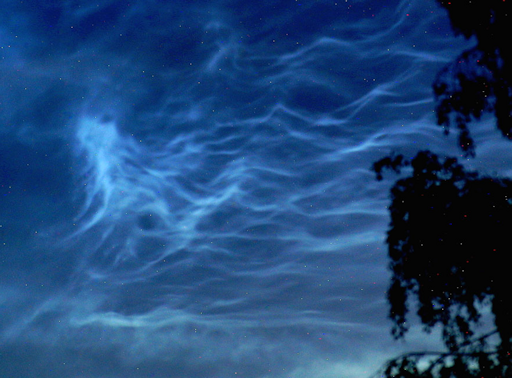
The luminous swirls in Nuke's picture are a sign of gravity waves.
Gravity waves are, essentially, waves of pressure and temperature kick-started in the lower atmosphere by, e.g., powerful storm systems. Gravity does not vary inside the waves; they get their name from the fact that gravity acts as a restoring force that tries to restore equilibrium to up-and-down moving air. Gravity waves can propagate all the way from Earth's surface up to the mesosphere, where they imprint themselves on the the forms of noctilucent clouds.
Often, gravity waves break in the noctilucent zone, dumping their energy and momentum there. Laser radar studies of noctilucent wave structures can trace this energy and tell researchers a great deal about upper atmospheric circulation.
Realtime Noctilucent Cloud Photo Gallery
SPACE LIGHTNING OVER EUROPE: Summer thunderstorm season is underway in Europe. As a result, space lightning is on the rise. Martin Popek photographed these specimens over Nýdek in the Czech republic on July 10th:

These are sprites--an exotic form of upper atmospheric electricity sometimes called "space lightning" because they reach altitudes associated with meteors, noctilucent clouds and auroras. Some researchers believe they are linked to cosmic rays: Subatomic particles from deep space striking the top of Earth's atmosphere produce secondary electrons that, in turn, could provide the spark that triggers sprites.
Although sprites have been seen for at least a century, most scientists did not believe they existed until after 1989 when sprites were photographed by cameras onboard the space shuttle. Now "sprite chasers" routinely photograph sprites from their own homes. "They are easily detected by certain cameras," says lightning scientist Oscar van der Velde of the Technical University of Catalonia, Spain. "If a storm is in the mood, you may record one every few minutes." Give it a try!

Realtime Space Weather Photo Gallery