NO SOLAR FLARES: Despite an uptick in the sunspot number, solar activity remains very low. The sun's X-ray output is flatlining as no sunspot seems capable of producing an explosion. NOAA forecasters say the chance of a strong flare today is no more than 1%. Solar flare alerts: text or voice

BALLOONING INTO THE SOUTH ATLANTIC ANOMALY: On July 18th, Spaceweather.com and the students of Earth to Sky Calculus will attempt a simultaneous launch of 3 space weather balloons from 2 continents. The goal of the flight is to measure the amount of atmospheric radiation in the South Atlantic Anomaly over Chile compared to similar latitudes in the USA. This has never been done before, and the results should be interesting.
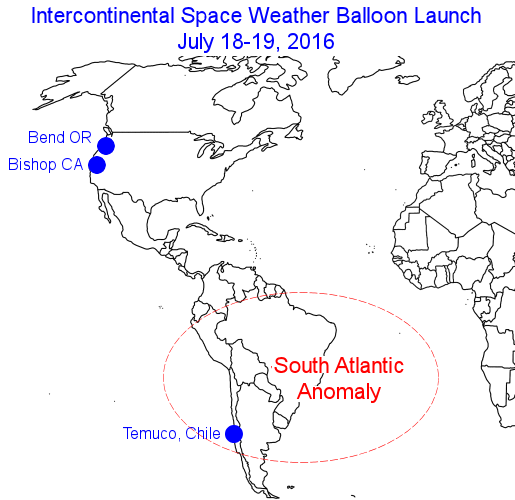
Students working with Spaceweather.com have been launching balloons into the stratosphere over California since May 2014. This triple balloon flight will expand upon those measurements to cover more than 70 degrees of latitude and 6,000 miles of geographical distance.
Of special interest is the South Atlantic Anomaly, a dip in the Earth's magnetic field which allows cosmic rays, and charged particles to reach lower into the atmosphere. We will be flying a balloon equipped with X-ray/gamma-ray sensors into the outskirts of the Anomaly from Temuco, Chile, measuring dose rates all the way from sea level to the stratosphere. Comparisons will be made with identical measurements far from the Anomaly in California and Oregon. Stay tuned!
Realtime Space Weather Photo Gallery
GEOMAGNETIC UNREST: For the 3rd day in a row, Earth is moving through a fast-moving stream of solar wind. Resulting G1-class geomagnetic storms have ignited some fantastic auroras over Antarctica. Yesterday at Argentina's Belgrano II base, researcher Saiquita Gabriel grabbed his guitar and joined the show:

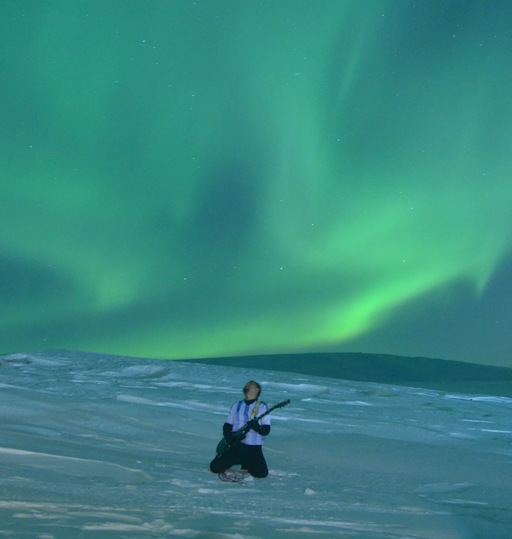
"It was a magical experience," says Gabriel. "I was so happy!"
The show's not over. Earth could be inside this broad stream of solar wind for as much as two more days. Dark winter skies in Antarctica favor continued visibility of southern lights--with an Argentine soundtrack, of course. Aurora alerts: text or voice
ELECTRIC BLUE GRAVITY WAVES: As July unfolds, sky watchers are seeing noctilucent clouds almost every night over northern Europe. Created by summertime water vapor freezing around meteor smoke in the upper atmosphere, the electric-blue forms can be mesmerizing. Consider this report from photographer Inta Nuke of Carnikava, Latvia: "July 10th was heavenly. I've never seen such bright, unusual shapes--almost mysterious." Almost. Scroll past Nuke's photo for an explanation:
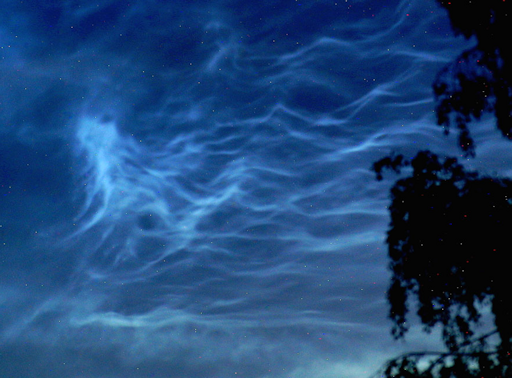
The luminous swirls in Nuke's picture are a sign of gravity waves.
Gravity waves are, essentially, waves of pressure and temperature kick-started in the lower atmosphere by, e.g., powerful storm systems. Gravity does not vary inside the waves; they get their name from the fact that gravity acts as a restoring force that tries to restore equilibrium to up-and-down moving air. Gravity waves can propagate all the way from Earth's surface up to the mesosphere, where they imprint themselves on the the forms of noctilucent clouds.
Often, gravity waves break in the noctilucent zone, dumping their energy and momentum there. Laser radar studies of noctilucent wave structures can trace this energy and tell researchers a great deal about upper atmospheric circulation.
Realtime Noctilucent Cloud Photo Gallery