CELESTIAL TRIANGLE: When the sun goes down tonight, step outside and look up. There's a celestial triangle in the southern sky. Vertices: the waxing full Moon, red Mars, and golden Saturn. Try to catch them before the sky fades completely black. The Moon and planets surrounded by twilight blue look extra-beautiful. [sky map]

SUPER NOCTILUCENT CLOUDS: Last night, a bank of intensely luminous noctilucent clouds (NLCs) rolled over northern Europe, filling the midnight sky with electric-blue ripples and swirls. "The clouds were very bright and beautiful," says Kairo Kiitsak, who sends this picture from Simuna, Estonia:

Similar displays were observed in England, Germany, Latvia, Lithuania, Russia, Scotland and the Netherlands. Across the Atlantic Ocean, the clouds even dipped down into the continental United States. Dustin Guy of Seattle, Washington, reports: "I witnessed the most vibrant NLC display that I've seen in a number of years. They lit up the water of Lake Washington at 330 AM local time."
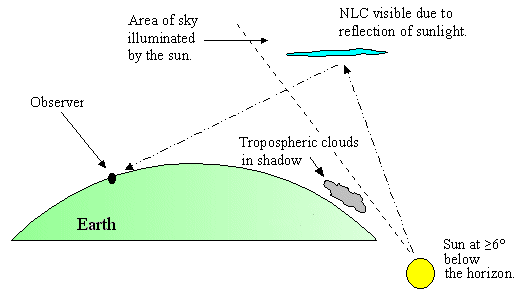
NLCs are Earth's highest clouds. They form at the edge of space more than 80 km above Earth's surface, when wisps of summertime water vapor wrap themselves around meteor smoke. The resulting ice crystals glow electric blue in the night sky.
In the 19th century, you had to travel near Arctic latitudes to see these clouds. In recent years, however, they have been sighted as far south as Colorado and Kansas. The spread could be a result of climate change.
Observing tips: Look west 30 to 60 minutes after sunset when the sun has dipped ~10 degrees below the horizon. If you see luminous blue-white tendrils spreading across the sky, you may have spotted a noctilucent cloud.
Realtime Noctilucent Cloud Photo Gallery
RAINBOW BREATHING WHALES: "Rainbow breathing whale" sounds like a mythical creature. On July 12th, Mila Zinkova of San Francisco saw one ... for real. She took this picture looking over the edge of the Golden Gate Bridge:

"A few humpback whales crossed under Golden Gate Bridge and entered the Bay," says Zinkova. "Just then I saw their rainbow-colored sprays. It was beautiful!"
This is not mythology. It's physics. When Zinkova took the picture, the sun was behind her back shining down into the droplet-filled exhaust of the whale's spout. Sunbeams reflecting from the water droplets produced a prismatic spray of color just like an ordinary rainbow.
Of course it didn't look ordinary. "The full video," says Zinkova, "may be found here."
Realtime Space Weather Photo Gallery