FAST-GROWING SUNSPOTS: Two days ago, big sunspot AR2565 was all alone. Today it has a new sunspot growing in its wake. Click on the arrow for 48 hours of action:

Emerging just behind AR2565, new sunspot AR2567 has an unstable 'beta-gamma-delta' magnetic field that harbors energy for strong M-class solar flares. Explosions in one sunspot have been known to trigger explosions in nearby sunspots, domino-style. Could AR2565 and AR2567 become such a duo? Stay tuned for updates.
NOCTILUCENT CLOUDS INVADE THE USA: Summer is the season for noctilucent clouds. For sky watchers in the United States, "noctilucent summer" has just begun. On July 14th, a bright bank of electric-blue clouds rippled over the Canadian border into the USA. Greg Johnson of Seattle, Washington, photographed the display over the Puget Sound:
Dustin Guy of Seattle saw them too. "I witnessed the most vibrant NLC display that I've seen in a number of years," he says. "They lit up the water of Lake Washington at 330 AM local time."
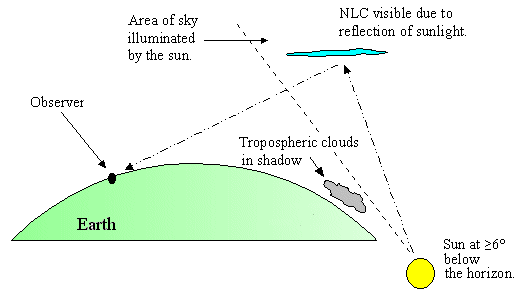
NLCs are Earth's highest clouds. They form at the edge of space more than 80 km above Earth's surface, when wisps of summertime water vapor wrap themselves around meteor smoke. The resulting ice crystals glow electric blue in the night sky.
In the 19th century, you had to travel near Arctic latitudes to see these clouds. In recent years, however, they have been sighted as far south as Colorado and Kansas. The spread could be a result of climate change. July is usually the best month for NLCs. Sky watchers in the northern half of the USA should be alert for them for the next two weeks.
Observing tips: Look west 30 to 60 minutes after sunset when the sun has dipped ~10 degrees below the horizon. If you see luminous blue-white tendrils spreading across the sky, you may have spotted a noctilucent cloud.
Realtime Noctilucent Cloud Photo Gallery
IRISH DOUBLE SUN HALOES: Noel Keating is an experienced photographer of the sky. He has seen plenty of auroras, noctilucent clouds, and even sun halos. "But I've never seen a double sun halo like the one that appeared over Co. Donegal in the republic of Ireland on July 14th," he says. "It was amazing!"

Sun halos are caused by ice crystals floating in cirrus clouds 5 to 10 km above the ground. Illuminated by sunlight, various crystal shapes give rise to luminous rings and arcs in the daytime sky. The most common halo is a 22 degree circle around the sun. Keating's picture captured that and more.
"There are actually three halos in this picture," says atmospheric optics expert Les Cowley. "The familiar 22 degree halo is the inner circle around the sun. Touching it at top and bottom is an outer oval, a circumscribed halo."
"The large circle crossing the sun, and hanging below it, is an unusual appearance of the parhelic circle. We normally see only fragments of the parhelic circle closer to the horizon. Here the sun is high and it has shrunk to a small circle around the zenith."
The clouds over the British isles must have been filled with such crystals yesterday because, says Cowley, "there were many halos over Ireland and Uk yesterday - a fine day for them." Look for more in the photo gallery:
Realtime Space Weather Photo Gallery