BIG SUNSPOTS--UPDATE: A pair of big sunspots is directly facing Earth. However, the chance of Earth-directed flares is decreasing as their magnetic fields have begun to decay on July 18th. Even without flares, these planet-sized spots are very photogenic. Take a look!
SOFIA'S SOUTHERN LIGHTS: The Stratospheric Observatory for Infrared Astronomy--a.k.a. "SOFIA"--is currently flying around New Zealand to study stars and galaxies in the Southern Hemisphere. On July 17th, astronomers inside the aircraft made an observation they didn't expect. Ian Griffin sends this report from an altitude of 41,000 feet: "I was lucky enough to have an observer's seat aboard tonight's SOFIA flight out of Christchurch," he says. "As we approached 60 degrees south latitude, the sky lit up in a beautiful display of aurora australis."

The airplane dipped as far south as -62 degrees latitude and crossed the international date line twice. The pilots' view was nearly as good as the astronomers'.

"Its now 5 am and I haven't slept for a day, but I have the biggest smile ever!" says Griffin. "SOFIA is an incredible machine, and to be aboard watching cutting edge science being done as an aurora blazed outside was a truly inspirational experience."
NOCTILUCENT CLOUDS INVADE THE USA: Summer is the season for noctilucent clouds. For sky watchers in the United States, "noctilucent summer" has just begun. On July 14th, a bright bank of electric-blue clouds rippled over the Canadian border into the USA. Greg Johnson of Seattle, Washington, photographed the display over the Puget Sound:
Dustin Guy of Seattle saw them too. "I witnessed the most vibrant NLC display that I've seen in a number of years," he says. "They lit up the water of Lake Washington at 330 AM local time."
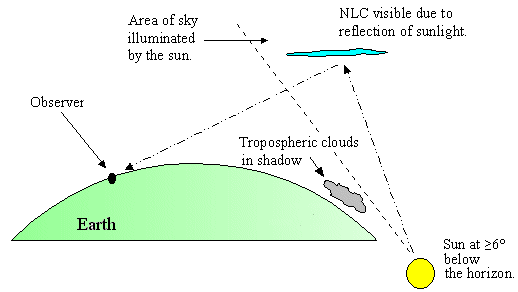
NLCs are Earth's highest clouds. They form at the edge of space more than 80 km above Earth's surface, when wisps of summertime water vapor wrap themselves around meteor smoke. The resulting ice crystals glow electric blue in the night sky.
In the 19th century, you had to travel near Arctic latitudes to see these clouds. In recent years, however, they have been sighted as far south as Colorado and Kansas. The spread could be a result of climate change. July is usually the best month for NLCs. Sky watchers in the northern half of the USA should be alert for them for the next two weeks.
Observing tips: Look west 30 to 60 minutes after sunset when the sun has dipped ~10 degrees below the horizon. If you see luminous blue-white tendrils spreading across the sky, you may have spotted a noctilucent cloud.
Realtime Noctilucent Cloud Photo Gallery
Realtime Space Weather Photo Gallery