NOCTILUCENT CLOUDS TONIGHT? Hours ago, photographer Andy Stables of Scotland reported a very bright display of noctilucent clouds--"the best show of the year so far here on the Isle of Skye," he says. Sky watchers in North America should be alert for a similar apparition as night falls over their continent. High-latitude observing sites such as Canada and northern-tier US states are favored. [photo gallery]
SOLAR ACTIVITY INTENSIFIES (UPDATED): Sunspot complex AR2565-AR2567 is crackling with M-class solar flares as magnetic fields threading the behemoth active regions stretch, twist, and re-connect. Mike Taormina photographed the sunspots' seething cores from his backyard observatory in Malta, New York:
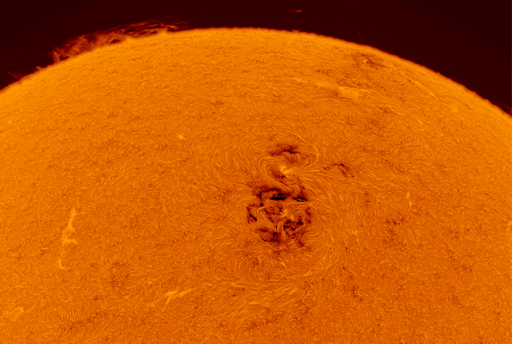
"The sun was alive with activity today!" says Taormina. "I am constantly amazed at the impressive level of detail that a small solar telescope can capture under good seeing conditions."
Update: A series of explosions crossing the July 20-21 UT day boundary hurled two CMEs away from the sun's southwestern limb. Coronagraph images from SOHO show that the clouds are not heading directly for Earth. Nevertheless, glancing blows to our planet's magnetic field may be possible in 2 to 3 days. NOAA analysts are modeling the CMEs trajectory now. Stay tuned for storm tracks.
Realtime Space Weather Photo Gallery
AFTER THE STORM, MAMMATUS CLOUDS: Yesterday, a severe thunderstorm swept through St Claude, Manitoba, drenching the landscape and cutting power to residents. "While waiting for power to be restored, I noticed these cloud formations drifting serenely overhead," reports Paul Moffat. "It seemed to make the storm's fury worthwhile."
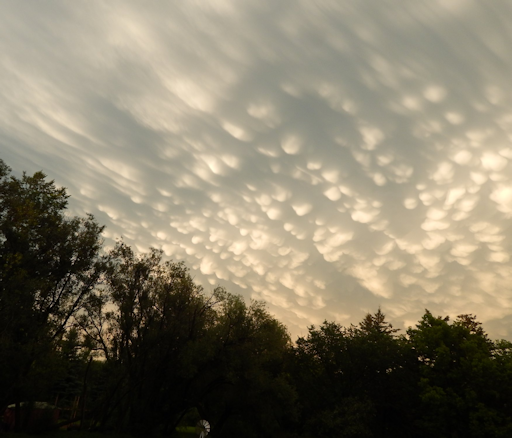
These are mammatus clouds. Named for their resemblance to a cow's underbelly, they often appear around the unstable edges of severe thunderstorms. Researchers have called mammatus clouds an "intriguing enigma," because they have not been studied as much as other clouds, and there is much uncertainty about how they form.
Photographers and artists have long valued mammatus clouds for their strangely beautiful appearance. Indeed, Gedzelman (1989) notes that the pendulous lobes appear in paintings as early as the 1500s. Mammatus clouds often go unnoticed because potential observers have been chased indoors by the rain. If you are one of them, go back outside when the downpour stops; you could witness a beautiful mystery in the sky.
Realtime Space Weather Photo Gallery
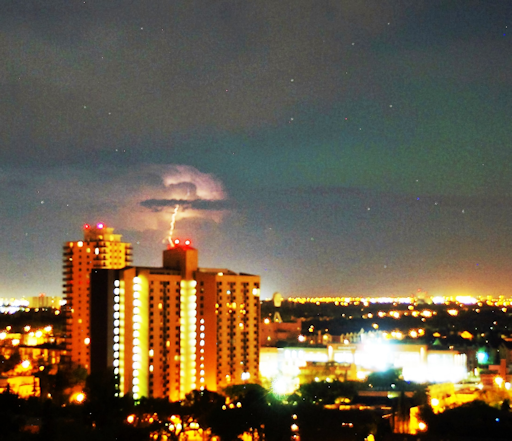
CME IMPACT SPARKS SUMMERTIME AURORAS: A CME struck Earth's magnetic field during the late hours of July 19th, sparking a G1-class geomagnetic storm. Green auroras were spotted in the northern hemisphere on July 20th despite glaring moonlight and summer thunderstorms. In Edmonton, Alberta, a perfectly-timed shot by photographer Rick Emas caught the auroras alongside a bolt of lightning:

In another case of good timing, hundreds of miles away, "a rainstorm came over the Glacier mountains of Montana just as the geomagnetic storm was peaking," says photographer Ray Stinson. Full moonlight mixed with raindrops to create a moonbow-aurora medley.
According to NOAA there is a 30% chance of more activity tonight. Earth is passing through a high-speed solar wind stream in the wake of the CME that could stir up additional G1-class magnetic storms. High-latitude sky watchers should remain alert for green lights behind the thunderclouds. Aurora alerts: text or voice
Realtime Noctilucent Cloud Photo Gallery