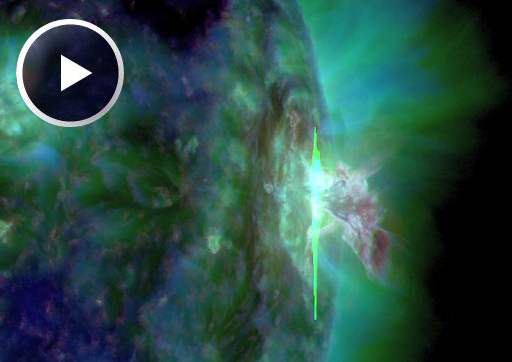
STRONGEST FLARE OF 2016: Sunspot complex AR2565-AR2567 erupted on July 23rd, twice, producing two strong solar flares in quick succession. The first @ 0211 UT registered M5 on the Richter Scale of Flares. The second @ 0516 UT registered M7.6, making it the strongest flare of 2016 so far. NASA's Solar Dynamics Observatory recorded the blast:
Pulses of radiation from the two flares ionized the top of Earth's atmosphere, causing a blackout of shortwave radio transmissions over the Pacific side of Earth. These maps from NOAA show the frequencies and territories affected. People who might have noticed the fading signals include ham radio operators, mariners and aviators.


The explosions hurled an impressive CME into space: movie. The cloud is not heading directly for Earth. However, there is a slim chance it could deliver a glancing blow to our planet's magnetic field in the days ahead. NOAA analysts are modeling the CME to evaluate this possibility. Stay tuned for updates.

Realtime Space Weather Photo Gallery
WHERE NO DUCK HAS GONE BEFORE: Yes, that really is a Vulcan rubber duck! The students of Earth to Sky Calculus flew the pointy-eared water bird to the stratosphere on July 19, 2016, as part of their ongoing program to monitor cosmic rays in the stratosphere. Here he is at the apex of the flight, 109,580 ft:
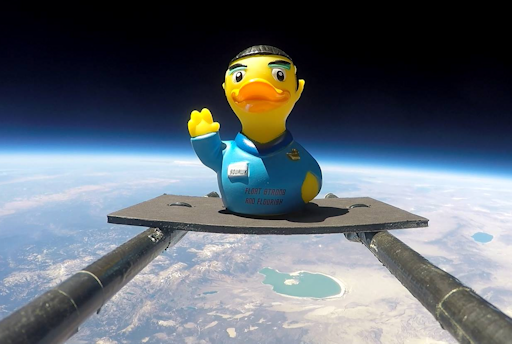
"Mr Squawk" hitchhiked on a helium balloon payload that carried an array of X-ray/gamma-ray sensors. By launching these sensors 3 or 4 times a month, the students have shown that cosmic rays are intensifying--a trend that affects mountain climbers, air travelers, high-altitude drones and astronauts on the International Space Station.
This research is crowd funded. Would you like to support it? Buy a duck! Edge of Space Vulcan Ducks are now available in the Earth to Sky Store.
THE SPHERICAL MILKY WAY: The Milky Way is beautiful. The Milky Way in 3D ... it's sublime. Last week on the island of La Palma, astrophotographers Karoline Mrazek and Erwin Matys used a Ricoh Theta S camera to photograph our own galaxy with a spherical lens. To see their results, click on the "theta" symbol:
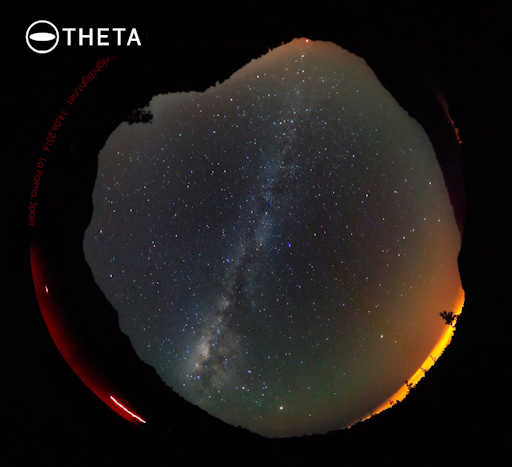
"The interactive spherical image shows the bright galactic center above the pitch black volcanic landscape of La Palma," says Mrazek and Matys. "The full band of the Milky Way is clearly visible as it crosses the zenith."
"This proves that it is possible to shoot low-light celestial objects such as the milky way and the zodiacal light with the Theta S. We did 25 exposures of 60 seconds at ISO 800 each for the sky and for the landscape. The individual images were stacked with Deep Sky Stacker and the two stacks were combined with Photoshop."
Mrazek and Matys are founding members of the astrophotography group project nightflight, and they've been testing the Ricoh Theta S in many settings for night-sky photography. Their complete report on spherical astrophotography is highly recommended. Read it here.
AFTER THE STORM, MAMMATUS CLOUDS: Yesterday, a severe thunderstorm swept through St Claude, Manitoba, drenching the landscape and cutting power to residents. "While waiting for power to be restored, I noticed these cloud formations drifting serenely overhead," reports Paul Moffat. "It seemed to make the storm's fury worthwhile."
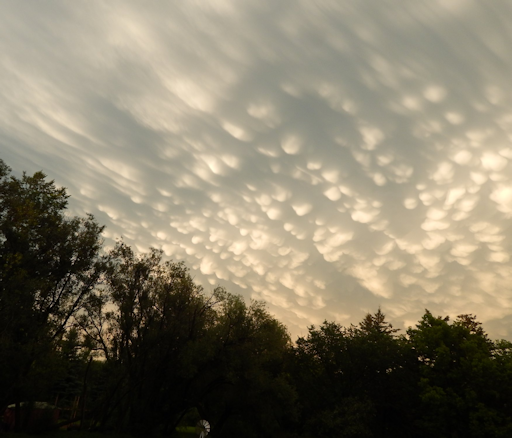
These are mammatus clouds. Named for their resemblance to a cow's underbelly, they often appear around the unstable edges of severe thunderstorms. Researchers have called mammatus clouds an "intriguing enigma," because they have not been studied as much as other clouds, and there is much uncertainty about how they form.
Photographers and artists have long valued mammatus clouds for their strangely beautiful appearance. Indeed, Gedzelman (1989) notes that the pendulous lobes appear in paintings as early as the 1500s. Mammatus clouds often go unnoticed because potential observers have been chased indoors by the rain. If you are one of them, go back outside when the downpour stops; you could witness a beautiful mystery in the sky.
Realtime Space Weather Photo Gallery
Realtime Noctilucent Cloud Photo Gallery