CHANCE OF STORMS TOMORROW: NOAA forecasters say there is a 45% chance of G1-class geomagnetic storms on July 26th when shock waves on the outskirts of a CME might deliver a glancing blow to Earth's magnetic field. High-latitude sky watchers should be alert for auroras. Aurora alerts: text or voice

SOUTHERN LIGHTS: A minor stream of solar wind is buffeting Earth's magnetic field. On July 25th, it caused a beautiful display of southern lights over New Zealand. "It was exciting to see such strong activity," says Taichi Nakamura who photographed the display from Dunedin on the South Island:
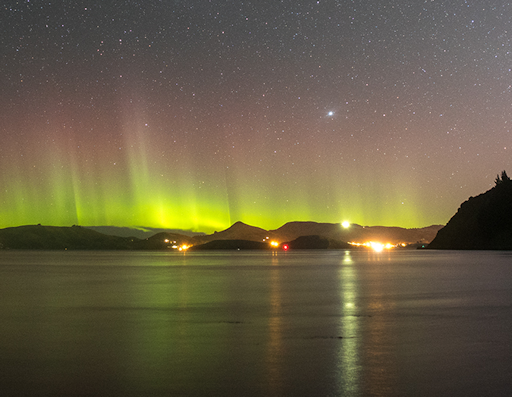
"Aurora kept rolling through, flowing from left to right following Earth's rotation," says Nakamura.
How did such a minor stream of solar wind produce such beautiful lights? It had help. Magnetic fields in the interplanetary space tilted south and linked up with Earth's magnetic field. This opened a crack in our planet's magnetosphere. Solar wind poured in to fuel the display.
HOW A CME CAN MISS EARTH AND STILL CAUSE A GEOMAGNETC STORM: A cluster of coronal mass ejections (CMEs) hurled into space by the strong flares of July 23rd will not hit Earth. They might spark a geomagnetic storm anyway. Scroll past the movie for reasons why.

Computer modeling by NOAA analysts suggest that the body of the combo-CME will sail wide of Earth. However, shock waves in the solar wind billowing away from the CME's outskirts might deliver a glancing blow to our planet's magnetic field. ETA: July 26th, the same day a solar wind stream is due to reach Earth. There is a 45% chance of G1-class geomagnetic storms in response to the shock waves + solar wind. High-latitude sky watchers should be alert for auroras on Tuesday night, especially in the southern hemisphere where dark winter skies favor visibility. Aurora alerts: text or voice
Realtime Space Weather Photo Gallery
EARTH'S SHADOW AND THE BELT OF VENUS: The other day, Göran Strand of Östersund, Sweden, was driving toward the sunset when he happened to glance in the rearview mirror. This is what he saw:
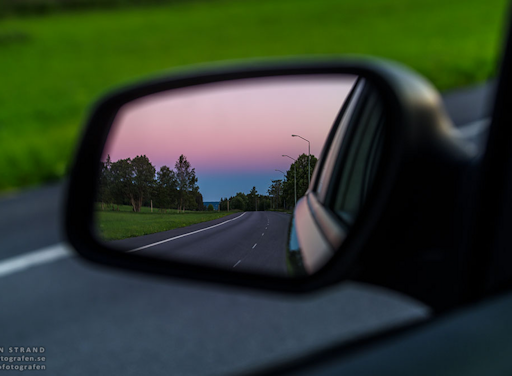
"As the sun was setting in the west, the shadow of Earth was rising behind me in the east," he says. "It is the navy-blue band just above the roadway."
Think about it. When you go outside at night, you are standing inside Earth's shadow. As the sun sets, the shadow rises. That's what night is.
"Above the blue shadow band you can also see a pink band commonly called the 'Belt of Venus,'" adds Strand. That is the transition zone between night and day.
Many people stare at the sunset. But "as the sun is setting, you should always look behind you," advises Strand. "It is beautiful there, too."
Realtime Space Weather Photo Gallery
WHERE NO DUCK HAS GONE BEFORE: Yes, that really is a Vulcan rubber duck! The students of Earth to Sky Calculus flew the pointy-eared water bird to the stratosphere on July 19, 2016, as part of their ongoing program to monitor cosmic rays in the stratosphere. Here he is at the apex of the flight, 109,580 ft:
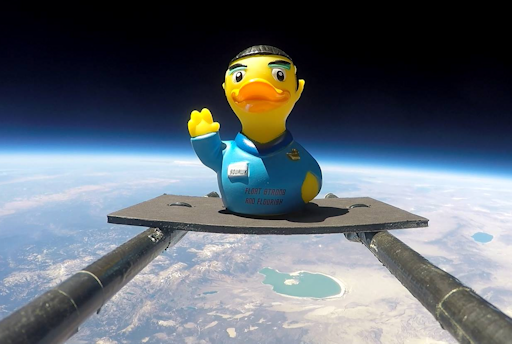
"Mr Squawk" hitchhiked on a helium balloon payload that carried an array of X-ray/gamma-ray sensors. By launching these sensors 3 or 4 times a month, the students have shown that cosmic rays are intensifying--a trend that affects mountain climbers, air travelers, high-altitude drones and astronauts on the International Space Station.
This research is crowd funded. Would you like to support it? Buy a duck! Edge of Space Vulcan Ducks are now available in the Earth to Sky Store.
Realtime Space Weather Photo Gallery
Realtime Noctilucent Cloud Photo Gallery