CHANCE OF STORMS TODAY: NOAA forecasters say there is a 45% chance of G1-class geomagnetic storms on July 26th when a high speed stream of solar wind is expected to hit Earth's magnetic field. The outskirts of a CME might deliver a glancing blow at about the same time. High-latitude sky watchers should be alert for auroras. Aurora alerts: text or voice


POLAR STRATOSPHERIC CLOUDS: The stratosphere is a relatively clear layer of Earth's atmosphere, almost always cloud-free. Almost always. Yesterday, researchers at Argentina's San Martín Base spotted a bank of fantastically colored clouds floating in the stratosphere above the Antarctic Peninsula:
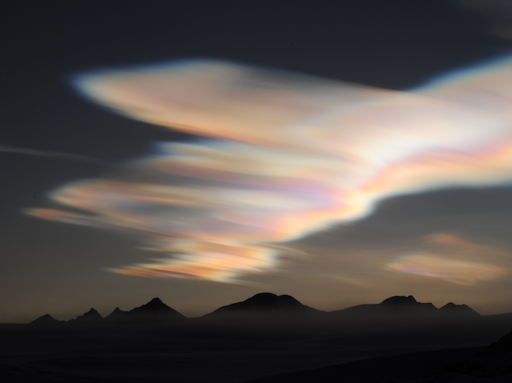
"There were the biggest stratospheric clouds we've seen so far this year," says photographer "Marcelo," who is working at the Base this winter. "It was a colorful spectacle to begin the day."
These are called "Polar Stratospheric Clouds" (PSCs). They form in the lower stratosphere when temperatures drop to around minus 85º C. This explains why they are rare; even at the poles, such low temperatures are hard to achieve. High-altitude sunlight shining through tiny (~10µm) ice particles in PSCs produce bright iridescent colors by diffraction and interference. Once thought to be mere curiosities, some PSCs are now known to be associated with the destruction of ozone.
Apparitions of these clouds often persist for days. Stay tuned for more sightings from the frozen continent.
NEW ZEALAND LIGHT SHOW: "It is rare to see the Aurora Australis from Wellington, which is on the North Island of New Zealand," says photographer Jonathan Usher. "However, last night I noticed a glow far to the south that twinkled and moved." He took this picture from coastal Seatoun:

There was no geomagnetic storm when the lights appeared. The display was caused by "southward Bz." In other words, magnetic fields in the space around Earth pried open a crack in our planet's magnetosphere. Solar wind poured in to spark the Southern Lights.
Similar displays were recorded in Queenstown and Dunedin. It was a good night to be in New Zealand.
WHERE NO DUCK HAS GONE BEFORE: Yes, that really is a Vulcan rubber duck! The students of Earth to Sky Calculus flew the pointy-eared water bird to the stratosphere on July 19, 2016, as part of their ongoing program to monitor cosmic rays in the stratosphere. Here he is at the apex of the flight, 109,580 ft:
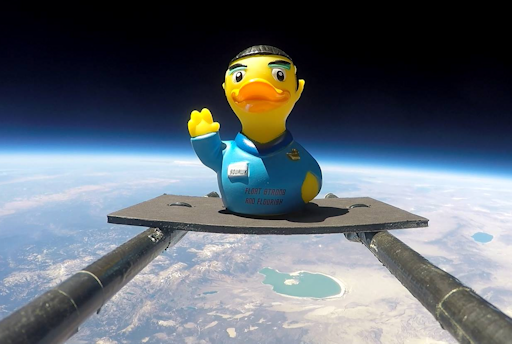
"Mr Squawk" hitchhiked on a helium balloon payload that carried an array of X-ray/gamma-ray sensors. By launching these sensors 3 or 4 times a month, the students have shown that cosmic rays are intensifying--a trend that affects mountain climbers, air travelers, high-altitude drones and astronauts on the International Space Station.
This research is crowd funded. Would you like to support it? Buy a duck! Edge of Space Vulcan Ducks are now available in the Earth to Sky Store.
Realtime Space Weather Photo Gallery
Realtime Noctilucent Cloud Photo Gallery