CHINESE ROCKET BURNS UP OVER NORTH AMERICA: The body of China's experimental Long March 7 rocket re-entered Earth's atmosphere on Wednesday night, July 27th, around 9:38 p.m. Pacific Time, creating a bright fireball over the western USA. The glowing trail was spotted in Utah, Nevada and much of California.

Ron Sappington photographed the breakup over Santa Clara, Utah: more.
The re-entry signaled the Long March 7's return from one month in space. It began its mission on June 25, 2016, in a night launch from the Wenchang Satellite Launch Center on Hainan Island off China's southern coast. The flight tested new technologies essential to China's developing space program. The Long March 7 is expected to play a key role in the construction of a Chinese space station planned for the decades ahead. [video]
THE PERSEID METEOR SHOWER IS BEGINNING: Earth is entering a broad stream of debris from comet Swift-Tuttle, source of the annual Perseid meteor shower. NASA cameras detected the first Perseid fireballs of 2016 on July 26th. This one, photographed over Mt. Lemmon Observatory in Arizona, was easily visible through the glare of a waning quarter moon:
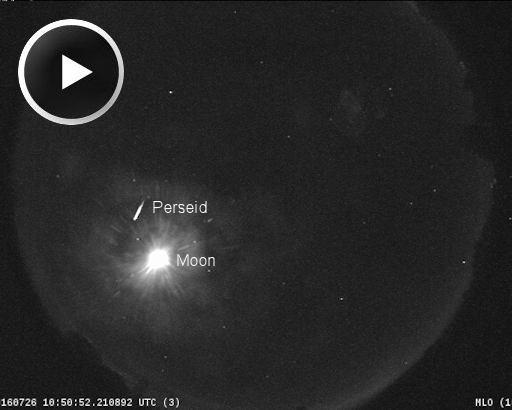
In the 48 hours since that first sighting, NASA's network of all-sky meteor cameras has detected more than half-a-dozen Perseid fireballs over the USA.
These numbers will grow sharply in the weeks ahead. Forecasters expect the shower to peak on August 11-13 with as many as 200 Perseids per hour. On those nights, Earth will pass through a dense thicket of debris from the parent comet, causing a display widely visible across the northern hemisphere. The 2016 Perseids are going to be great. Stay tuned for observing tips and more information. Meteor alerts: text or voice
THE SUN IS BLANK AGAIN: The sunspot number is zero again following the departure of sunspot complex AR2565-AR2567 on Monday. Today's photo from NASA's Solar Dynamics Observatory shows a solar disk that is completely blank:
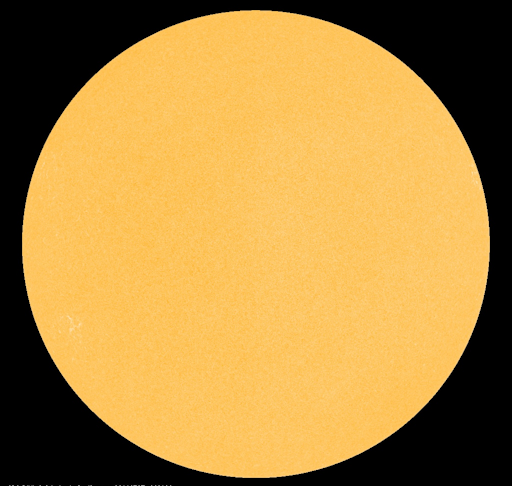
Blank suns are a sign that Solar Maximum is over and Solar Minimum is coming--a natural transition of the 11-year sunspot cycle. Contrary to popular belief, however, Solar Minimum is not boring. It brings a time of enhanced cosmic rays, extra sprites and elves, a collapsing ionosphere and accumulating space junk. With action like that, who needs solar flares?
It's worth noting that Solar Minimum isn't here yet. Indeed, only one half of the sun is blank. Sunspot complex AR2565-AR2567 still exists on the farside of the sun, and it could return ~10 days from now when the sun's rotation spins those dark cores back around in our direction. Until then, stay tuned for blank suns. Solar flare alerts: text or voice
Realtime Space Weather Photo Gallery
WHERE NO DUCK HAS GONE BEFORE: Yes, that really is a Vulcan rubber duck! The students of Earth to Sky Calculus flew the pointy-eared water bird to the stratosphere on July 19, 2016, as part of their ongoing program to monitor cosmic rays in the stratosphere. Here he is at the apex of the flight, 109,580 ft:
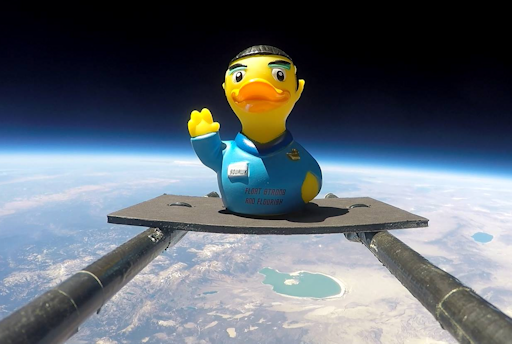
"Mr Squawk" hitchhiked on a helium balloon payload that carried an array of X-ray/gamma-ray sensors. By launching these sensors 3 or 4 times a month, the students have shown that cosmic rays are intensifying--a trend that affects mountain climbers, air travelers, high-altitude drones and astronauts on the International Space Station.
This research is crowd funded. Would you like to support it? Buy a duck! Edge of Space Vulcan Ducks are now available in the Earth to Sky Store.
Realtime Noctilucent Cloud Photo Gallery