COSMIC RAYS AND HEART DISEASE: A new study just published in the journal Scientific Reports concludes that Apollo astronauts who traveled to the Moon were 4 to 5 times more likely to die of cardiovascular disease than astronauts who never went beyond low Earth orbit. The culprit: cosmic rays. According to the authors "[space radiation] induces a sustained vascular endothelial cell dysfunction. Such impairment is known to lead to occlusive artery disease, and may be an important risk factor for cardiovascular disease among astronauts exposed to deep space radiation." Something to think about if you're planning a trip to Mars....
INCOMING SOLAR STORM: During the late hours of July 28th, a filament of magnetism erupted on the sun, slingshotting a cloud of plasma (CME) into space. Scroll past the movie of the CME to learn when it will hit Earth:
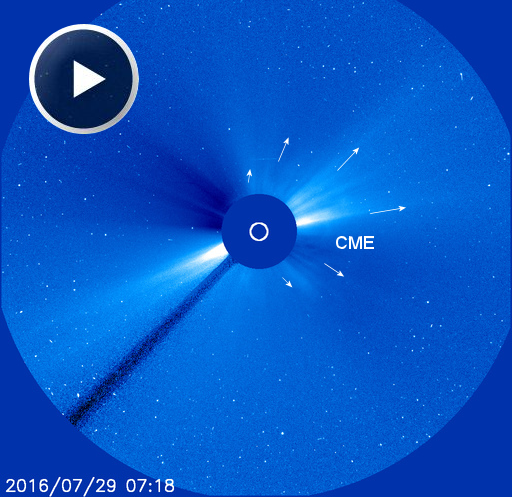
NOAA analysts have computer-modeled the trajectory of this CME, and they say it is likely to strike Earth's magnetic field on August 1st. This is not a major storm cloud. Nevertheless, the impact could spark G1-class geomagnetic storms. High-latitude sky watchers should be alert for auroras when the CME arrives. Aurora alerts: text or voice

SUNRISE IN ANTARCTICA: After two months of almost total winter darkness, the sun is rising again on the outskirts of Antarctica. B Sudarsan Patro sends this picture from the Bharati Indian Base Station in the Larsemann Hills overlooking Prydz Bay (69o S):
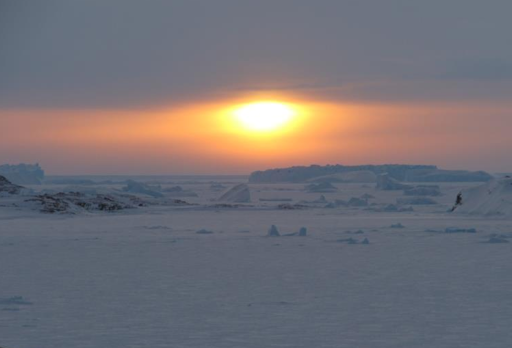
"Today we have observed a colorful sunrise and sunset," says Patro. "After a long wait of 65 days, the polar sun appeared and it was absolutely stunning. We all are happy to see the sun with new rays of hope."
Of course, the return of the Antarctic sun reduces the hours for watching Southern Lights. But daytime has its rewards, too. Stay tuned for more images from the frozen continent.

Realtime Space Weather Photo Gallery
WHERE NO DUCK HAS GONE BEFORE: Yes, that really is a Vulcan rubber duck! The students of Earth to Sky Calculus flew the pointy-eared water bird to the stratosphere on July 19, 2016, as part of their ongoing program to monitor cosmic rays in the stratosphere. Here he is at the apex of the flight, 109,580 ft:
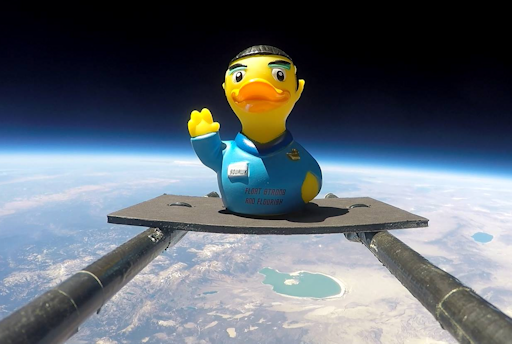
"Mr Squawk" hitchhiked on a helium balloon payload that carried an array of X-ray/gamma-ray sensors. By launching these sensors 3 or 4 times a month, the students have shown that cosmic rays are intensifying--a trend that affects mountain climbers, air travelers, high-altitude drones and astronauts on the International Space Station.
This research is crowd funded. Would you like to support it? Buy a duck! Edge of Space Vulcan Ducks are now available in the Earth to Sky Store.
Realtime Noctilucent Cloud Photo Gallery