COSMIC RAYS AND HEART DISEASE: A new study just published in the journal Scientific Reports concludes that Apollo astronauts who traveled to the Moon were 4 to 5 times more likely to die of cardiovascular disease than astronauts who never went beyond low Earth orbit. The culprit: cosmic rays. According to the authors "[space radiation] induces a sustained vascular endothelial cell dysfunction. Such impairment is known to lead to occlusive artery disease, and may be an important risk factor for cardiovascular disease among astronauts exposed to deep space radiation." Something to think about if you're planning a trip to Mars....
INCOMING SOLAR STORM: During the late hours of July 28th, a filament of magnetism erupted on the sun, slingshotting a cloud of plasma (CME) into space. Scroll past the movie of the CME to learn when it will hit Earth:
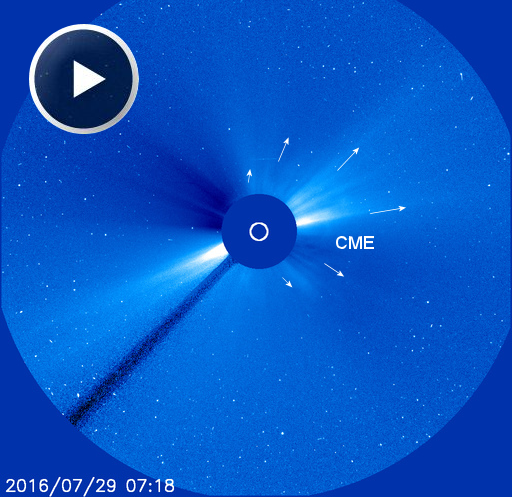
NOAA analysts have computer-modeled the trajectory of this CME, and they say it is likely to strike Earth's magnetic field late on August 1st. This is not a major storm cloud, but it is not alone. A solar wind stream is following closely behind it. The double blow could strongly disturb Earth's polar magnetic field. NOAA forecasters say there is a 70% chance of G1 or G2-class geomagnetic storms on Aug. 2nd. Aurora alerts: text or voice

A MYSTERIOUS FORM OF AURORA: Humans have been watching the aurora borealis for thousands of years, with scientific studies of the phenomenon underway for centuries. Despite all that watching and studying, however, there are still some auroral forms that remain a mystery--namely, the "proton arc." This one appeared over the Grande Cache area of Alberta, Canada, on July 29th:
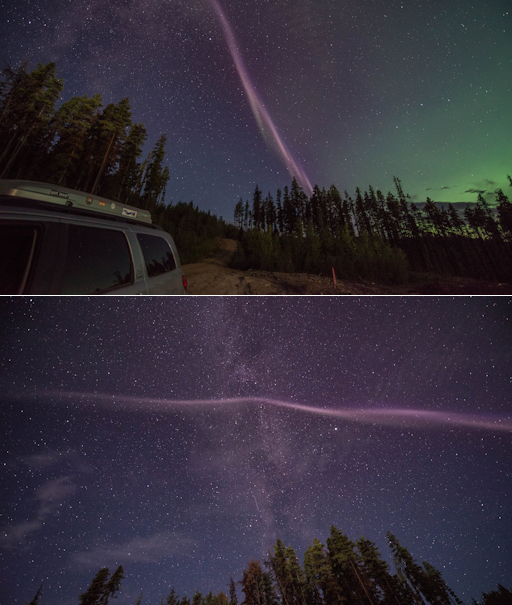
"As I was driving to the Kakwa river, I saw a purple 'proton arc' crossing the sky from east to west, pulsing and dancing with the Northern lights," says photographer Catalin Tapardel. "Quite a show...."
Aurora photographers see these structures from time to time--tight ribbons of light, sometimes red, sometimes green, writhing across the night sky. They are commonly called "proton arcs."
Yet aurora scientists say they probably have nothing to do with protons.
"My opinion, and I believe the consensus of most aurora scientists, is that these arcs are not proton related, " says Jason Ahrns, a researcher at the University of Alaska Fairbanks, "but I don't know what does cause them."
"Ordinary auroras we see from the ground and space are caused by electrons precipitating down into the atmosphere," says Dennis Gallagher of the NASA Marshall Space Flight Center. "Protons can cause auroras, too, but they are different. For one thing, proton auroras are brightest in the UV part of the spectrum, invisible to the human eye."
There is some visible light from proton auroras, but the structures they make are not tight and filamentary, but rather broad and diffuse--"in part because the gyroradius of protons is large," says Ahrns. In other words, massive protons circle around magnetic fields in broad lazy arcs unlike lightweight electrons, which can tightly circle magnetic fields to form narrow structures.
Ahrns photographed an authentic proton aurora in February 2014: photo. "It appearance matched the description of proton arcs in the scientific literature - 'a dim and diffuse glow' with 'very little structure in the observed brightness' with a total brightness of only a few kiloRayleighs, which is just on the verge of visual threshold (Lummerzheim 2001)."

So what are the "proton arcs" often photographed by amateur aurora chasers? "I don't know," says Ahrns, "but it is something many of us would like to get to the bottom of!" For more examples of this mystery in the sky, browse the Proton Arc Photo Gallery.
Realtime Proton Arc Photo Gallery
WHERE NO DUCK HAS GONE BEFORE: Yes, that really is a Vulcan rubber duck! The students of Earth to Sky Calculus flew the pointy-eared water bird to the stratosphere on July 19, 2016, as part of their ongoing program to monitor cosmic rays in the stratosphere. Here he is at the apex of the flight, 109,580 ft:
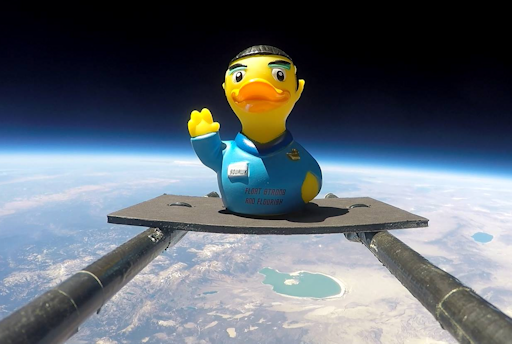
"Mr Squawk" hitchhiked on a helium balloon payload that carried an array of X-ray/gamma-ray sensors. By launching these sensors 3 or 4 times a month, the students have shown that cosmic rays are intensifying--a trend that affects mountain climbers, air travelers, high-altitude drones and astronauts on the International Space Station.
This research is crowd funded. Would you like to support it? Buy a duck! Edge of Space Vulcan Ducks are now available in the Earth to Sky Store.
Realtime Space Weather Photo Gallery
Realtime Noctilucent Cloud Photo Gallery