DOOMED COMET: The sun is about to swallow a comet. The doomed sungrazer appeared earlier today in images from the Solar and Heliospheric Observatory (SOHO):

"This is one of the brightest Kreutz sungrazers we've seen over the past 21 yrs," says Karl Battams of the Naval Research Lab in Washington DC. "Awesome! "
Kreutz sungrazers are fragments from the breakup of a single giant comet many centuries ago. They get their name from 19th century German astronomer Heinrich Kreutz, who studied them in detail. Kreutz fragments pass by the sun and disintegrate almost every day. Most, measuring less than a few meters across, are too small to see, but occasionally a bigger fragment like this one attracts attention.
The comet is vaporizing furiously and is not expected to survive much longer. Monitor the SOHO realtime images page for developments.
SUMMERTIME AURORAS: As expected, a CME embedded in a high-speed solar wind stream hit Earth's magnetic field during the late hours of Aug. 2nd. The resulting G1-class geomagnetic storm spilled into Aug.3rd, sparking a beautiful display of summertime auroras around the northern hemisphere. Jüri Voit sends this picture from Estonia:


"Our first aurora lights after the summer holidays were beautiful indeed," says Voit.
Similar displays were sighted over Germany, Denmark, Sweden, Minnesota, Wyoming, Ontario and, on the opposite end of the Earth, Antarctica.
The show's not over. NOAA forecasters say there is a 55% chance of additional storms on Aug. 3rd as the solar wind continues to blow. High latitude sky watchers should remain alert for auroras. Aurora alerts: text or voice
WHAT HAPPENED TO SDO? NASA's Solar Dynamics Observatory (SDO) is in an geosynchronous orbit high above Earth with a 24/7 view of the sun. Occasionally, however, the Moon gets in the way. Yesterday, Aug. 2nd, SDO observed a beautiful eclipse as the dark lunar disk moved in front of the sun:
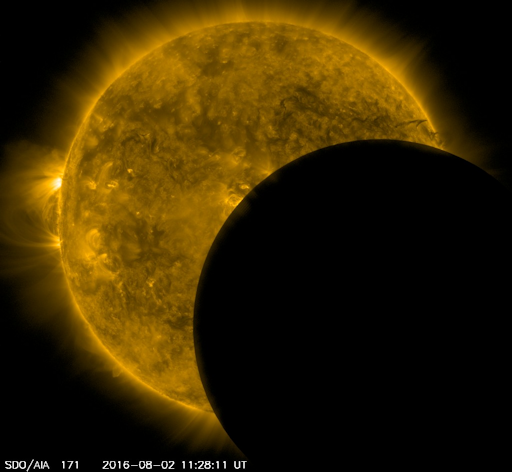
SDO has recorded many lunar transits like this one since the observatory was launched in 2010. This one was different from the others in one important way:
"The spacecraft did not go back into Science mode at the end of the transit," writes Dean Pesnell of NASA/Goddard on the SDO blog. "SDO FOT members are looking into the issue."
Since the transit no new data have appeared on SDO public websites. We hope all is well! Stay tuned for updates about this crucial solar sentinel.
GREEN-BLOODED BOBBLEHEAD: The 50th Anniversary of Star Trek is now. To celebrate (and to support their crowdfunded research program) the students of Earth to Sky Calculus flew the pointy-eared science officer to the stratosphere on July 24, 2016. Here he is at the apex of the flight, more than 32.2 km (112,200 ft) above Earth's surface:
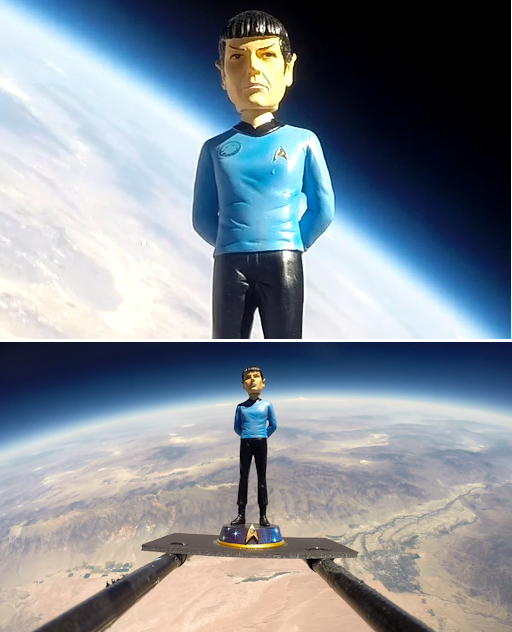
You can buy this collector's item for only $129.95 in the in the Earth to Sky Store.
Proceeds from the sale support space weather research. Bobblehead Spock hitchhiked on a helium balloon payload that carried an array of X-ray/gamma-ray sensors. By launching these sensors 3 or 4 times a month, the students have shown that cosmic rays are intensifying--a trend that affects mountain climbers, air travelers, high-altitude drones, and astronauts on the International Space Station.
Realtime Space Weather Photo Gallery
Realtime Noctilucent Cloud Photo Gallery