COMPLETE DESTRUCTION OF A COMET: Earlier today, a comet dove into the sun. It did not come back out again. SOHO (the Solar and Heliospheric Observatory) witnessed the disappearance:

"That was the total destruction of a 600 km/s snowball, witnessed exclusively by SOHO," says Karl Battams of the Naval Research Lab in Washington DC. "My good friend and colleague Matthew Knight estimated the comet peaked at ~mag -0.5, putting it squarely in the top ten (five?) of SOHO's brightest Kreutz sungrazers."
Kreutz sungrazers are fragments from the breakup of a single giant comet many centuries ago. They get their name from 19th century German astronomer Heinrich Kreutz, who studied them in detail. Kreutz fragments pass by the sun and disintegrate almost every day. Most, measuring less than a few meters across, are too small to see, but occasionally a bigger fragment like this one attracts attention.
SUMMERTIME AURORAS: It's not often that a flash of lightning and distant peal of thunder makes you look up and see ... green. Yet that's what happened on the night of Aug.2-3 when auroras backlit a summer thundercloud over Center, Wisconsin. Extreme weather photographer Jeremy Friebel captured the moment:

"I took the picture from cornfield around 1 am," says Friebel.
The display occurred scant hours after a solar wind stream hit Earth's magnetic field, igniting a G1-class geomagnetic storm. At high latitudes, a rare apparition of summertime auroras lit the skies of the northern hemisphere. Thunder heralded green lights over Canada, Europe, and a handful of northern-tier US States.

The odds of more auroras are waning as Earth exits the solar wind stream. NOAA forecasters say there is a 40% chance minor geomagnetic storms on August 4th. Aurora alerts: text or voice
GREEN-BLOODED BOBBLEHEAD: The 50th Anniversary of Star Trek is now. To celebrate (and to support their crowdfunded research program) the students of Earth to Sky Calculus flew the pointy-eared science officer to the stratosphere on July 24, 2016. Here he is at the apex of the flight, more than 32.2 km (112,200 ft) above Earth's surface:
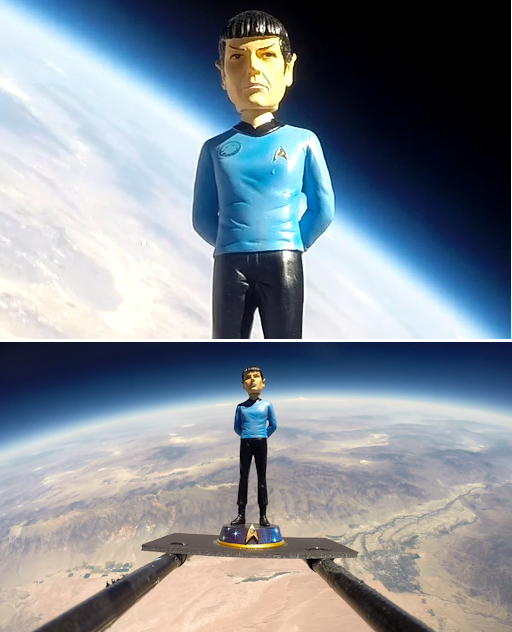
You can buy this collector's item for only $129.95 in the in the Earth to Sky Store.
Proceeds from the sale support space weather research. Bobblehead Spock hitchhiked on a helium balloon payload that carried an array of X-ray/gamma-ray sensors. By launching these sensors 3 or 4 times a month, the students have shown that cosmic rays are intensifying--a trend that affects mountain climbers, air travelers, high-altitude drones, and astronauts on the International Space Station.
Realtime Space Weather Photo Gallery
Realtime Noctilucent Cloud Photo Gallery