SUNSET PLANETS: When the sun goes down tonight, Aug. 5th, step outside and look west. Jupiter and the slender crescent Moon are having a close encounter only ~1 degree apart. Try to catch them before the sky fades to black. A bright conjunction framed by deep twilight blue is a wonderful sight, indeed. [sky map]

In a preview of tonight's conjunction, on Aug.4th photographer Yuri Beletsky caught the crescent Moon passing by Mercury en route to Jupiter above Chile's Atacama desert:
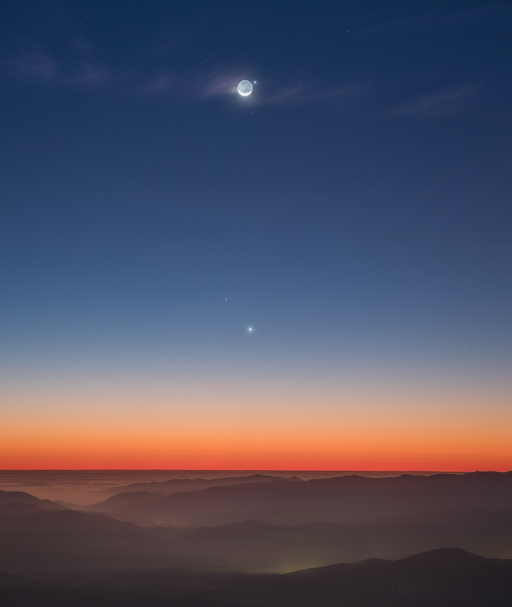
"We were so lucky to witness a truly amazing scene - Moon and Mercury in close dance just above bright Venus soon after the sunset," says Beletsky.
Realtime Space Weather Photo Gallery
ANTARCTIC LIGHTS: For the third day in a row, Earth is inside a fast-moving stream of solar wind. This has caused almost non-stop auroras over Antarctica. Gabriel Saiquita sends this self-portrait from Argentina's Belgrano II research station at latitude -78° S:
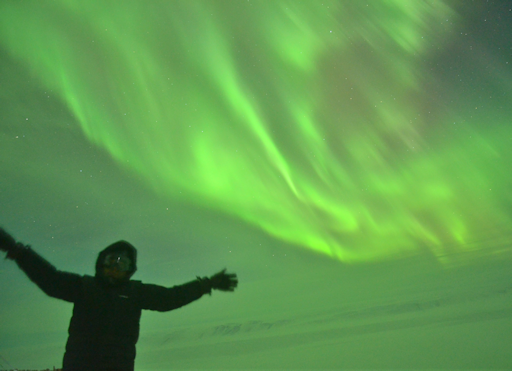
"Las auroras fueron muy grandes por un momento (hace un tiempo largo que no tuvimos auroras como estas) y logre tomar estas increibles fotos," says Saiquita.
Observers at the Maitri Indian Research Base on the Schirmacher oasis and the Bharati Indian Base Station in the Larsemann Hills have also reported spectacular lights.
NOAA forecasters say there is a 40% chance of G1-class geomagnetic storms on Aug. 5th as the solar wind speed continues to run high. Antarctic sky watchers--all ~1000 of them--should remain alert for auroras. Aurora alerts: text or voice

GREEN-BLOODED BOBBLEHEAD: The 50th Anniversary of Star Trek is now. To celebrate (and to support their crowdfunded research program) the students of Earth to Sky Calculus flew the pointy-eared science officer to the stratosphere on July 24, 2016. Here he is at the apex of the flight, more than 32.2 km (112,200 ft) above Earth's surface:
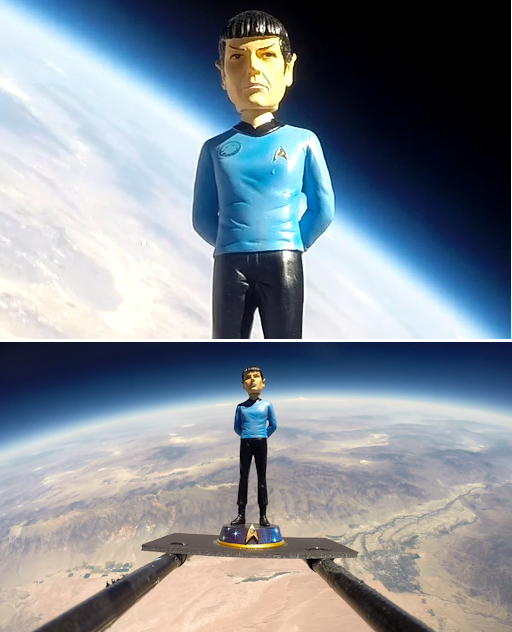
You can buy this collector's item for only $129.95 in the in the Earth to Sky Store.
Proceeds from the sale support space weather research. Bobblehead Spock hitchhiked on a helium balloon payload that carried an array of X-ray/gamma-ray sensors. By launching these sensors 3 or 4 times a month, the students have shown that cosmic rays are intensifying--a trend that affects mountain climbers, air travelers, high-altitude drones, and astronauts on the International Space Station.
Realtime Noctilucent Cloud Photo Gallery