SOLAR WIND: NOAA forecasters say that a high-speed (700 km/s) stream of solar wind might hit Earth's magnetic field on Aug. 15-16. Its arrival could spark G1-class geomagnetic storms and high-latitude auroras. Glare from the nearly full Moon will, however, mitigate visibility. Aurora alerts: text or voice

SPACE LIGHTNING OVER CHINA: For the past few nights, people around the world have been pointing their cameras at the night sky hoping to catch Perseid meteors. Phebe Pan was one of them, and on Aug. 13th he saw something more amazing any meteoroid. "To observe the shower I went to Shi Keng Kong, the highest mountain peak in the Guangdong province of China," Pan says. "I was using a fisheye lens to capture as much of the sky as possible. Suddenly we saw a flash of blue and purple ejected from the top of a nearby thundercloud."
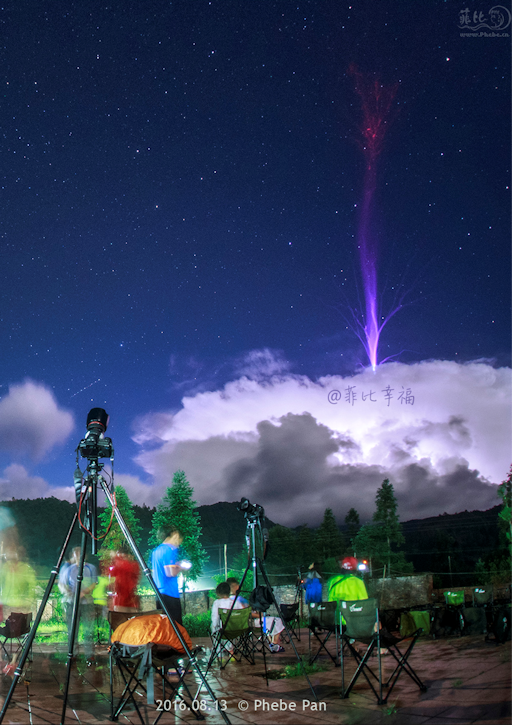
Oscar van der Velde, a member of the Lightning Research Group at the Universitat Politècnica de Catalunya, explains what Pan saw: "This is a very lucky capture of a gigantic jet. It's the first time I've seen one captured using a fisheye lens!"
Think of them as sprites on steroids: Gigantic jets are lightning-like discharges that spring from the tops of thunderstorms, reaching all the way to the ionosphere more than 50 miles overhead. They're enormous and powerful.
"Gigantic jets are much more rare than sprites," says van der Velde. "While sprites were discovered in 1989 and have since been photographed by the thousands, it was not until 2001-2002 that gigantic jets were first recorded from Puerto Rico and Taiwan." Only a few dozen gigantic jets have ever been seen.
Like their cousins the sprites, gigantic jets reach all the way up to the edge of space alongside meteors, noctilucent clouds, and some auroras. This means they are a true space weather phenomenon. Indeed, some researchers believe cosmic rays help trigger these exotic forms of lightning, but the link is controversial.
NOCTILUCENT CLOUDS: NASA's AIM spacecraft, which monitors noctilucent clouds (NLCS) from space, is offline for the next few months while engineers upload a software patch. Meanwhile,observers on the ground are still seeing the electric-blue ripples. Satu Juvonen sends this picture from Raakkyla, Finland:
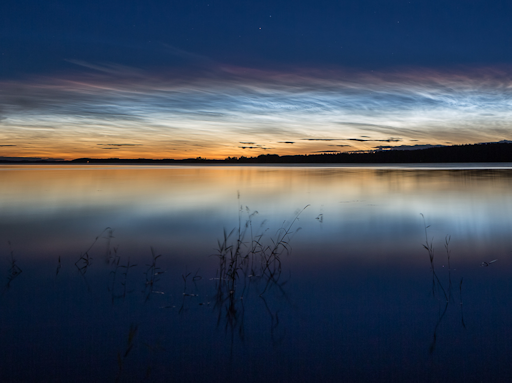
"The noctilucent clouds were incredibly bright on Aug. 13th," says Juvonen. "The display was also special because it had a red fringe on top."
Indeed, that is odd. Noctilucent clouds are best known for their azure hue. Why? The clouds are made of microscopic ice crystals, which form when summertime wisps of water vapor rise to the top of Earth's stratosphere and freeze around microscopic specks of meteor smoke. Very tiny crystals, such as the ones found in NLCs, scatter blue light.
So where did the red fringe come from? Members of the AIM science team asked to explain it weren't sure. One of them, Cora Randall from the University of Colorado, speculated that "light being scattered by the NLCs in this band might be encountering some sort of fine dust layer in the troposphere, which preferentially scatters blue light out of the line of sight, resulting in a reddish tint to the NLCs."
Realtime Noctilucent Cloud Photo Gallery
Realtime Perseid Photo Gallery
Realtime Space Weather Photo Gallery