CO-ROTATING INTERACTION REGION: A co-rotating interaction region (CIR) is expected to hit Earth's magnetic field on Aug. 19th. CIRs are transition zones between slow- and fast-moving solar wind streams. Shock waves and density gradients inside these regions often do a good job sparking auroras. NOAA forecasters say there is a 40% chance of G1-class geomagnetic storms when the CIR arrives. Aurora alerts: text or voice

MORE SPACE LIGHTNING: Phebe Pan wasn't the only photographer who saw a gigantic jet in China on Aug. 13th. Li Hualong photographed one too--leaping up from the same thunderstorm. This photo shows the jet about 100 km from Phebe Pan's location. Read the news item below for more information.
SPACE LIGHTNING OVER CHINA: On Aug. 13th in China, photographer Phebe Pan was photographing the night sky, hoping to catch a Perseid meteor. Instead, he witnessed a spectacular bolt of "space lightning." Working atop Shi Keng Kong, the highest mountain peak in the Guangdong province, "I was using a fisheye lens to capture as much of the sky as possible," says Pan. "Suddenly we saw a flash of blue and purple ejected from the top of a nearby thundercloud. It just looked like a tree with branches, and grew up very fast. So awesome!"
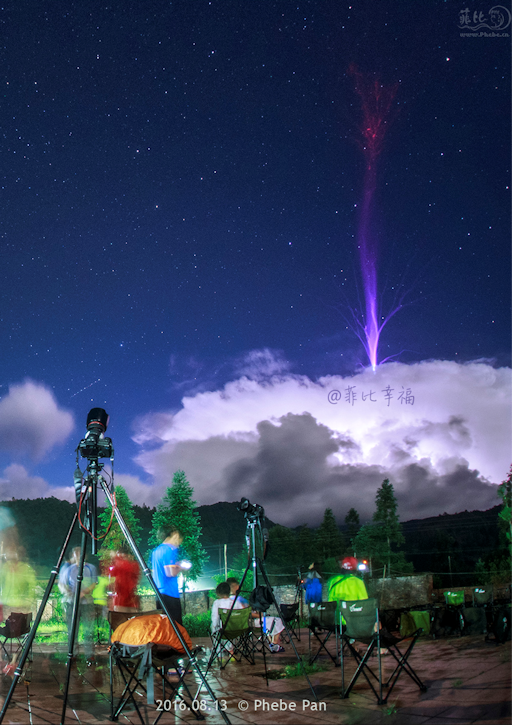
Oscar van der Velde, a member of the Lightning Research Group at the Universitat Politècnica de Catalunya, explains what Pan saw: "This is a very lucky capture of a gigantic jet. It's the first time I've seen one captured using a fisheye lens!"
Think of them as sprites on steroids: Gigantic jets are lightning-like discharges that spring from the tops of thunderstorms, reaching all the way to the ionosphere more than 50 miles overhead. They're enormous and powerful.
"Gigantic jets are much more rare than sprites," says van der Velde. "While sprites were discovered in 1989 and have since been photographed by the thousands, it was not until 2001-2002 that gigantic jets were first recorded from Puerto Rico and Taiwan." Only a few dozen gigantic jets have ever been seen.
Like their cousins the sprites, gigantic jets reach all the way up to the edge of space alongside meteors, noctilucent clouds, and some auroras. This means they are a true space weather phenomenon. Indeed, some researchers believe cosmic rays help trigger these exotic forms of lightning, but the link is controversial.
INTERCONTINENTAL BALLOON NETWORK: Aug 21, 2016, is an important date. It's the one year pre-anniversary of the Great American Solar Eclipse. On Aug. 21, 2017, the Moon will pass in front of the sun, producing a total eclipse visible from coast to coast in the USA. To record the eclipse as never before, Spaceweather.com and the students of Earth to Sky Calculus will lead more than a dozen teams of citizen scientists in launching balloons through the path of totality. Our goal: to photograph the eclipse from the stratosphere and create a unique movie of the Moon's shadow sweeping across the continent. Such an ambitious project requires practice, and we're starting now:
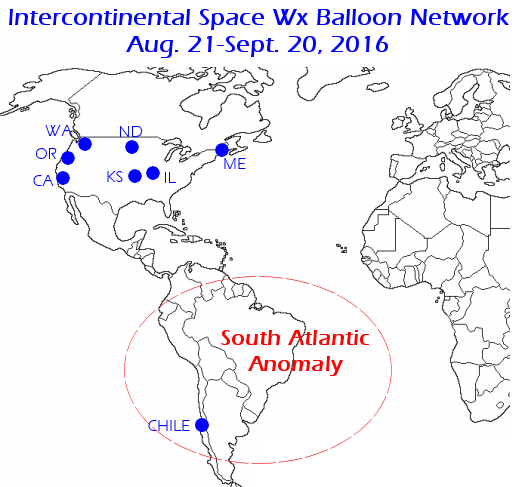
For the next month, we'll be launching groups of balloons from multiple sites around North and South America. Each site (including the one in Chile) will be crewed by students and teachers involved in the Solar Eclipse Balloon Network. Launching large numbers of balloons simultaneously is a key logistical challenge for the 2017 eclipse, and this will be good practice indeed. The first launch on Aug. 21st will involve as many as four balloons lifting off from Chile, California, Oregon and Illinois.
Because our standard eclipse payload includes radiation sensors, we will be learning a great deal about the geographical distribution of cosmic rays in Earth's atmosphere. The Chilean launch, in particular, promises interesting results as it occurs directly beneath the South Atlantic Anomaly. Stay tuned!
Realtime Space Weather Photo Gallery