SUBSIDING CHANCE OF STORMS: A co-rotating interaction region (CIR) expected to hit Earth's magnetic field on Aug. 19th did not arrive as expected. Probably, the sharp transition zone between slow- and fast-moving solar wind streams (i.e., the CIR) dissipated before it reached our planet. As a result, NOAA forecasters have downgraded the chance of geomagnetic storms today to only 15%. Aurora alerts: text or voice
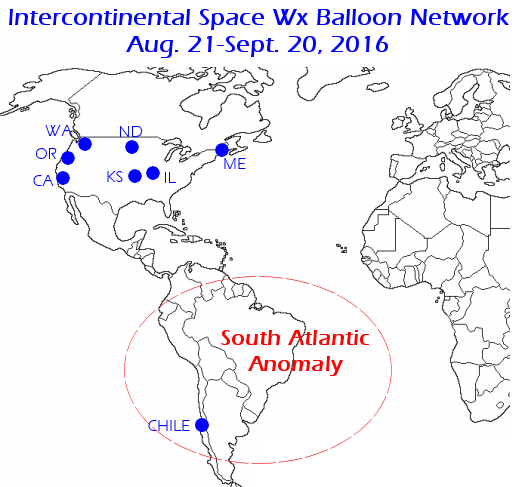
SPACE WEATHER BALLOON EXPERIMENT--NOW! For the next fews days, the staff of Spaceweather.com will be busy with a 10,000 mile wide experiment. Together with the students of Earth to Sky Calculus, we are launching space weather balloons from multiple sites in two continents:
Our purpose is two-fold:
First, it's a giant experiment in atmospheric radiation. Our payloads contain radiation sensors that allow us to measure cosmic rays from deep space. We will find out how this penetrating form of radiation varies around the Americas at altitudes ranging from ground level to the stratosphere. The results will be especially interesting in Chile, where the balloon will ascend into the South Atlantic Anomaly, a high radiation zone caused by a weakness in Earth's magnetic field.
Second, we're practicing for Aug. 21, 2017--the date of the Great American Solar Eclipse. One year from now, we will launch more than a dozen balloons into the path of totality to photograph the eclipse from the stratosphere and create a unique movie of the Moon's shadow sweeping across North America. Such an ambitious project requires practice, and we're starting now.
Update: The Chilean team launched their balloon on Aug. 20th, and the flight appears to have been a success. The payload landed in Argentina where a recovery team will go and look for it today. Also today, Aug. 21st, two more balloons will be launched simultaneously from Bishop CA and Bend OR. Stay tuned for updates from those flights.

Above: Scenes from the Chilean space weather balloon launch on Aug. 20, 2016
PLANETS IN THE SUNSET SKY: Venus and Jupiter are converging in the sunset sky for a close encounter on Aug.27th. Yesterday in the Snowy Mountains of NSW Australia, Phil Hart photographed the two bright planets approaching one another with Mercury looking on:

"A highlight of six days backcountry skiing in NSW was the planetary alignment of Venus, Mercury and Jupiter," says Hart. "It took a few nights to get the weather and scenery to cooperate, but after an hour of trapsing around and lying down in the snow, I managed to capture this shot on our last night out."
The view will improve in the evenings ahead as the distance between Jupiter and Venus decreases. At closest approach on Aug 27th, the two worlds will appear only about 1/15th of a degree apart. If you hold a pencil at arm's length, the eraser would cover both planets at once. Moreover, Venus and Jupiter will easily fit within a telescopic field of view--an amazing sight if you have a backyard telescope.
Remember, though, that a telescope is not required. Venus and Jupiter are bright enough to see with the naked eye even from light-polluted urban areas. Try to catch them about 30 minutes after sunset before the sky fades completely black. The sight of two planets in conjunction surrounded by twilight blue is extra-beautiful.
Realtime Space Weather Photo Gallery
Realtime Noctilucent Cloud Photo Gallery