NASA REGAINS CONTACT WITH LOST SPACECRAFT: In a surprising development, NASA has regained contact with the STEREO-B spacecraft after two years of silence. STEREO-B, which can see the farside of the sun, went quiet in 2014 after mission controllers tested a communications reset procedure. Unfortunately, STEREO-B failed the test. Since then, NASA has regularly attempted to regain contact using the Deep Space Network. On Aug. 21st, they succeeded, managing to receive a downlink carrier for several hours. In the days and weeks ahead, engineers will take steps to assess the health of STEREO-B and return it to service. Solar flare alerts: text or voice
GEOMAGNETIC STORM: A G1-class geomagnetic storm is underway on Aug. 23rd as Earth passes through a stream of solar wind filled with negative polarity (-Bz) magnetic fields. The ongoing disturbance has sparked some of the first auroras of the season over Finland:


"The auroras started to glow during the twilight and I did continue watching them for hours until the clouds started rolling in later in the night," says photographer Rauno Pakarinen of Lake Pieksäjärvi, Finland. "It was our first real auroral display of early autumn."
High-latitude sky watchers should remain alert for auroras on Aug. 23-24 as Earth moves through this unexpected stream of solar wind. NOAA forecasters estimate a 20% chance of minor geomagnetic storms, but the actual odds are probably higher as a result of the stream's aurora-friendly magnetization. Aurora alerts: text or voice
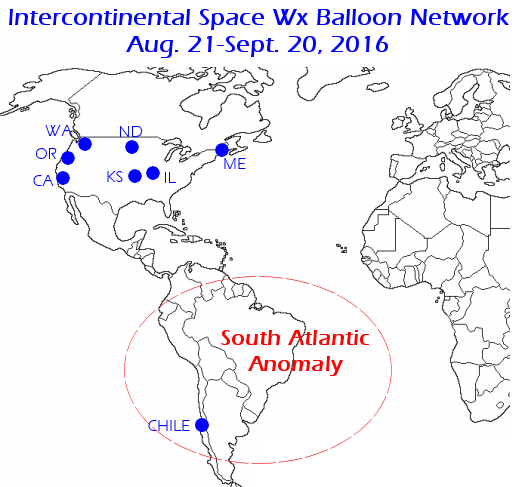
SPACE WEATHER BALLOON OVER THE ANDES: Spaceweather.com and the students of Earth to Sky Calculus have just released four space weather balloons in less than three days--from Chile, California, Oregon, and Washington. The rapid-fire launches are in support of the Intercontinental Space Weather Balloon Network, which spans 3 countries, two continents, and more than 10,000 miles. A highlight so far is the Chilean launch of Aug 20th. That balloon reached an altitude of 37.4 km (122,700 feet), a record for our 5 year-old ballooning program. Here is the space weather payload soaring over the Andes:

The purpose of our (exhausting) activity is two-fold:
First, it's a giant experiment in atmospheric radiation. Our payloads contain radiation sensors that allow us to measure cosmic rays from deep space. We will find out how this penetrating form of radiation varies around the Americas at altitudes ranging from ground level to the stratosphere. The results will be especially interesting in Chile, where the balloon ascended into the South Atlantic Anomaly, a high radiation zone caused by a weakness in Earth's magnetic field.
Second, we're practicing for Aug. 21, 2017--the date of the Great American Solar Eclipse. One year from now, we will launch more than a dozen balloons into the path of totality to photograph the eclipse from the stratosphere and create a unique movie of the Moon's shadow sweeping across North America. Such an ambitious project requires practice, and we're starting now.
Stay tuned for updates as the launches continue.
Realtime Space Weather Photo Gallery
Realtime Noctilucent Cloud Photo Gallery