SOLAR SECTOR BOUNDARY CROSSING: On Aug. 28th, Earth will cross a fold in the heliospheric current sheet. This "solar sector boundary crossing" could disturb our planet's magnetic field and spark auroras at high latitudes. NOAA forecasters estimate a 25% chance of G1-class geomagnetic storms. Aurora alerts: text or voice

SUNSET CONJUNCTION: Venus and Jupiter are converging for a beautiful conjunction in the sunset sky. The best place to see it is the southern hemisphere. Helio C. Vital sends this picture from Rio de Janeiro, Brazil:

"Shown in the photos are Venus, Jupiter and Mercury forming a triangle in Rio's evening twilight sky," says Vital. "Ascending Venus can be seen 3.1° below descending Jupiter as they quickly approach each other, heading for a very close encounter on Aug. 27th."
At closest approach on Saturday evening, the two worlds will appear only about 1/15th of a degree apart. If you hold a pencil at arm's length, the eraser would cover both planets at once. Moreover, Venus and Jupiter will easily fit within a telescopic field of view--an amazing sight if you have a backyard telescope.
As easy as this is to see in the southern hemisphere, it will be difficult to see on the other side of the equator. In the northern hemisphere, the planets hug the horizon at sunset, barely visible in the bright orange glow of early twilight. Northerners, monitor the photo gallery to see what you are missing.
Realtime Space Weather Photo Gallery
COSMIC RAYS AND CLOUDS--NEW RESULTS: The connection between cosmic rays and clouds has long been controversial. Some researchers hold that cosmic rays hitting Earth's atmosphere create aerosols which, in turn, seed clouds. This could make cosmic rays an important player in weather and climate. Other researchers, however, are less convinced. Although some laboratory experiments support the idea that cosmic rays help seed clouds, skeptics say the effect is too small to substantially affect the cloudiness of our planet or to avert the course of climate change.
A new study just published in the Aug. 19th issue of Journal of Geophysical Research: Space Physics comes down in favor of cosmic rays. A team of scientists from the Technical University of Denmark (DTU) and the Hebrew University of Jerusalem has linked sudden decreases in cosmic rays (called "Forbush Decreases") to changes in Earth's cloud cover.
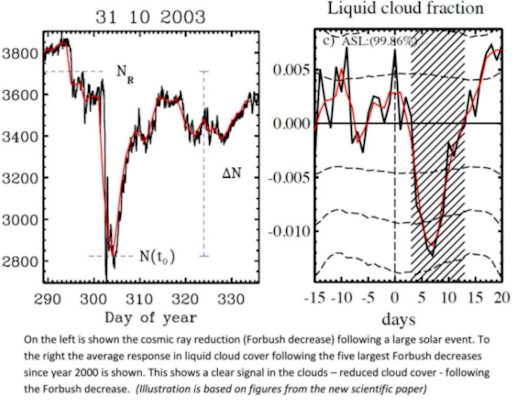
Forbush Decreases occur when solar storms called "coronal mass ejections (CMEs)" sweep past Earth. Magnetic fields in CMEs deflect cosmic rays and, essentially, sweep some of the cosmic rays away from our planet. The research team led by Jacob Svensmark of DTU identified the strongest 26 Forbush Decreases between 1987 and 2007, and looked at ground-based+satellite records of cloud cover to see what happened. In a press release, their conclusions were summarized as follows: "[Strong Forbush Decreases] cause a reduction in cloud fraction of about 2 percent corresponding to roughly a billion tonnes of liquid water disappearing from the atmosphere."
If true, that's amazing. It would also underscore the importance of measuring cosmic rays in the atmosphere. Recent balloon flights by Spaceweather.com and Earth to Sky Calculus show that cosmic rays are intensifying. Cloudy days, anyone? Stay tuned for updates.
Realtime Noctilucent Cloud Photo Gallery