QUIET WITH A CHANCE OF FLARES: Solar activity is low, however, it might not remain so. Big sunspot AR2585 is developed an unstable 'beta-gamma' magnetic field that harbors energy for moderately strong solar flares. NOAA forecasters estimate a 20% chance of M-flares on Sept. 3rd. Solar flare alerts: text or voice
HIGH-SPEED SOLAR WIND SPARKS AURORAS: A stream of very fast moving solar wind is buffeting Earth's magnetic field this weekend, and this is causing geomagnetic storms around the poles. A twilight display in Lofoten, Norway, on Sept. 3rd prompted one photographer to move his dinner table outside:

"I had a plan to invite my dear for a glass of wine this evening," says June Grønseth. "Due to a burst of light from the sky, I just had to change the seating from inside to outside my home. Here in Lofoten, we are really enjoying life."
The solar wind is flowing from an unusually large coronal hole on the sun, shown here in an image from NASA's Solar Dynamics Observatory:

Coronal holes are regions in the sun's atmosphere where the magnetic field opens up and allows solar wind to escape. This hole is spewing a stream of solar wind so broad, it could influence Earth's space environment for days to come. High-latitude sky watchers should remain alert for auroras throughout the weekend. Aurora alerts: text or voice
SUNSET PLANETS: Last night, careful observers of the sunset may have noticed a close encounter between Jupiter and crescent Moon. For many, the meeting was blocked by low hanging clouds. "Flying at 39,000 feet definitely improved visibility," says Mark Staples, who took this picture from the window seat of an airplane over South Carolina:

"We were flying over the remains of Hurricane Hermine," says Staples. "It was hard to get a clear, motionless, undistorted pic thru the airplane window, but the storm clouds made for a spectacular sunset."
More images of the conjunction, including this rare daytime shot, may be found in the realtime photo gallery:
Realtime Space Weather Photo Gallery
 |
| Cosmic Rays in the Atmosphere |
|
Updated: Sept.3, 2016 // Next Flight: Sept. 10, 2016
Sept. 3, 2016: On Sept. 2nd, Spaceweather.com and the students of Earth to Sky Calculus conducted a successful transcontinental launch of two space weather balloons--one from New Hampshire and another from California. The New Hampshire balloon recorded the highest levels of atmospheric radiation since our monitoring program began two years ago. Students are reducing the data now, and we will report the results in the coming week.
While you wait, here is a shot of the Atlantic coast of Maine taken during the Sept. 2nd balloon flight from an altitude of 118,000 feet:

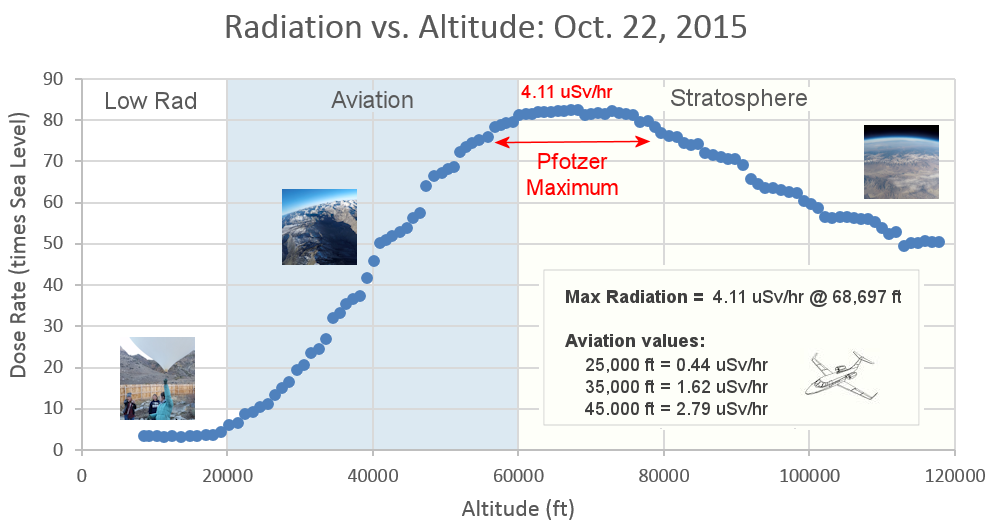
Approximately once a week, Spaceweather.com and the students of Earth to Sky Calculus fly space weather balloons to the stratosphere over California. These balloons are equipped with radiation sensors that detect cosmic rays, a surprisingly "down to Earth" form of space weather. Cosmic rays can seed clouds, trigger lightning, and penetrate commercial airplanes. Furthermore, there are studies ( #1, #2, #3, #4) linking cosmic rays with cardiac arrhythmias and sudden cardiac death in the general population. Our latest measurements show that cosmic rays are intensifying, with an increase of almost 13% since 2015:

Why are cosmic rays intensifying? The main reason is the sun. Solar storm clouds such as coronal mass ejections (CMEs) sweep aside cosmic rays when they pass by Earth. During Solar Maximum, CMEs are abundant and cosmic rays are held at bay. Now, however, the solar cycle is swinging toward Solar Minimum, allowing cosmic rays to return. Another reason could be the weakening of Earth's magnetic field, which helps protect us from deep-space radiation.
The radiation sensors onboard our helium balloons detect X-rays and gamma-rays in the energy range 10 keV to 20 MeV. These energies span the range of medical X-ray machines and airport security scanners.
The data points in the graph above correspond to the peak of the Reneger-Pfotzer maximum, which lies about 67,000 feet above central California. When cosmic rays crash into Earth's atmosphere, they produce a spray of secondary particles that is most intense at the entrance to the stratosphere. Physicists Eric Reneger and Georg Pfotzer discovered the maximum using balloons in the 1930s and it is what we are measuring today.
THIS RESEARCH IS CROWD-FUNDED: The cosmic ray research presented on Spaceweather.com is done by students, driven by curiosity, and funded entirely by readers. Our latest flight over California on Aug. 21st was sponsored by World Tech Toys of Valencia CA. In exchange for their generous donation of $750, we flew a toy Striker Drone to the edge of space:
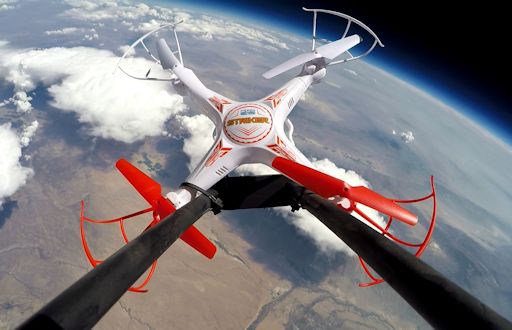
HD video and poster-quality images of the drone in space are now being used by World Tech Toys for marketing and outreach--an out-of-this-world bargain.
Our next flights on Sept. 2nd and Sept. 10th need sponsors. Would you like to assist? Contact Dr. Tony Phillips to make arrangements.