AURORA SEASON BEGINS TODAY: Today is the first day of northern autumn. That means aurora season has begun. For reasons that researchers don't fully understand, geomagnetic storms love equinoxes. At this time of year, even a gentle gust of solar wind can spark a bright display of lights around the Arctic circle. More: Autumn is Aurora Season
NEW! RADS ON A PLANE: Spaceweather.com is now reporting data you won't find anywhere else: Regular measurements of cosmic rays at aviation altitudes. Approximately once a week, we launch high-altitude balloons equipped with X-ray/gamma-ray sensors. En route to the stratosphere over California the payload passes through aviation altitudes. Here are 18 months' worth of data at 25,000 ft and 40,000 ft:

In this plot, dose rates are expressed as multiples of sea level. For instance, we see that boarding a plane that flies at 25,000 feet exposes passengers to dose rates ~10x higher than sea level. At 40,000 feet, the multiplier is closer to 50x.
Cosmic rays and solar activity have a yin-yang relationship. When the sun grows quiet (as it has been doing), cosmic rays increase. We have already observed this effect in the stratosphere, where radiation levels have increased by more than 12% since 2015. Will these increases eventually trickle down to aviation altitudes? Our monitoring program will answer that question as the solar cycle continues to ebb.
To view the latest data, scroll down from here to the section entitled "Cosmic Rays in the Atmosphere."
CHINESE SPACE STATION SIGHTED: Last week, on Sept. 15th, China launched a new space station to Earth orbit: Tiangong-2. The 10-meter long spacecraft is only a fraction the size of the ISS, but there is room inside for two tiakonauts (Chinese astronauts) and plenty of science experiments. And in dark skies, it can be seen with the naked eye. On Sept. 20th, Kevin Fetter of Brockville, Ontario, Canada, video-recorded the Tiangong-2 passing by the bright star Zeta Ophiuchi:
"At the time the space station was passing the star, its magnitude was near +5," estimates Fetter."It got into the 4th magnitude range just before it disappeared into Earth's shadow. So it is a naked-eye object, albeit barely."
Tiangong-2 is the second of three prototype space stations China plans to launch as the country builds toward a Mir-class outpost in the next decade. Tiangong-2's predecessor, Tiangong-1, is still in orbit and expected to burn up in Earth's atmosphere sometime in 2017.
Next month, China will launch a crew of two to inhabit the new space station for approximately 30 days. While on board, they will test Tiangong-2's life support system, and possibly conduct experiments in brain-machine interfacing, atomic clock navigation, and quantum communications.
Ready to see for yourself? Tiangong-2 flyby predictions are available from Heavens Above. "Use the Satellite Database and search for object '41765' labeled 'OBJECT A,'" advises Fetter. "That's how to find it."
Update: Last night, Sept. 21st, Gary of Fort Davis, Texas, saw the new space station flying over his own backyard:

"It streaked through Ursa Minor not far from the North Star," he says. "Shining like a 4th magnitude star, Tiangong-2 was brighter than I expected."
Realtime Space Weather Photo Gallery
SOLAR WIND SPARKS AURORAS: A fast-moving stream of solar wind is buffeting Earth's magnetic field. In response, auroras are dancing around the Arctic Circle. "The magnetic storm hit us as expected [on Sept.20th]!" reports Rayann Elzein from the UNESCO Ilulissat Icefjord World Heritage site in Greenland. "We had such an amazing show!"

"Imagine the icebergs calving in the background and hearing some whales going about in the sea around the fjord with a huge corona forming above our heads!" describes Elzein. "The bright moon was a superb addition to the magic."
He also photographed a surprising splash of red among the green. "We could not dream for a better background," he says.

More auroras are possible tonight as Earth as the solar wind continues to blow. Monitor the photo gallery for sightings. Free: Aurora Alerts
 |
| Cosmic Rays in the Atmosphere |
|
Updated: Sept. 20, 2016 // Next Flight: Sept. 27, 2016
Sept. 20, 2016: Readers, thank you for your patience while we continue to develop this new section of Spaceweather.com. We've been working to streamline our data reduction, allowing us to post results from balloon flights much more rapidly, and we have developed a new data product, shown here:
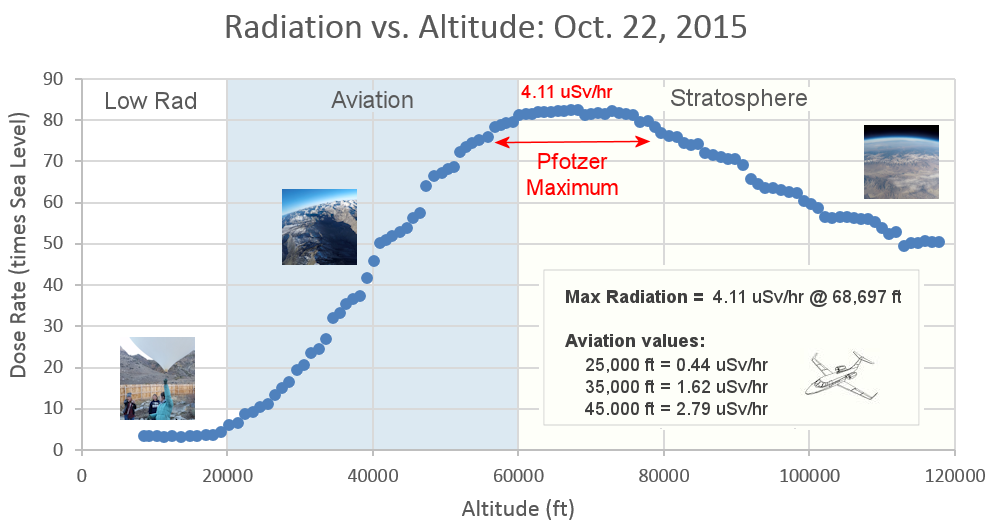
This plot displays radiation measurements not only in the stratosphere, but also at aviation altitudes. Dose rates are expessed as multiples of sea level. For instance, we see that boarding a plane that flies at 25,000 feet exposes passengers to dose rates ~10x higher than sea level. At 40,000 feet, the multiplier is closer to 50x. These measurements are made by our usual cosmic ray payload as it passes through aviation altitudes en route to the stratosphere over California.
What is this all about? Approximately once a week, Spaceweather.com and the students of Earth to Sky Calculus fly space weather balloons to the stratosphere over California. These balloons are equipped with radiation sensors that detect cosmic rays, a surprisingly "down to Earth" form of space weather. Cosmic rays can seed clouds, trigger lightning, and penetrate commercial airplanes. Furthermore, there are studies ( #1, #2, #3, #4) linking cosmic rays with cardiac arrhythmias and sudden cardiac death in the general population. Our latest measurements show that cosmic rays are intensifying, with an increase of more than 12% since 2015:

Why are cosmic rays intensifying? The main reason is the sun. Solar storm clouds such as coronal mass ejections (CMEs) sweep aside cosmic rays when they pass by Earth. During Solar Maximum, CMEs are abundant and cosmic rays are held at bay. Now, however, the solar cycle is swinging toward Solar Minimum, allowing cosmic rays to return. Another reason could be the weakening of Earth's magnetic field, which helps protect us from deep-space radiation.
The radiation sensors onboard our helium balloons detect X-rays and gamma-rays in the energy range 10 keV to 20 MeV. These energies span the range of medical X-ray machines and airport security scanners.
The data points in the graph above correspond to the peak of the Reneger-Pfotzer maximum, which lies about 67,000 feet above central California. When cosmic rays crash into Earth's atmosphere, they produce a spray of secondary particles that is most intense at the entrance to the stratosphere. Physicists Eric Reneger and Georg Pfotzer discovered the maximum using balloons in the 1930s and it is what we are measuring today.