GEOMAGNETIC STORM UNDERWAY: Earlier today, Sept. 25th, Earth crossed through a fold in the heliospheric current sheet--a vast wavy structure in interplanetary space separating regions of opposite magnetic polarity. The crossing has disturbed our planet's magnetic field, and a minor G1-class geomagnetic storm is now underway. High-latitude sky watchers should be alert for auroras tonight. [photo gallery]

CORONAL HOLE TURNING TOWARD EARTH: A vast "coronal hole" has opened up in the sun's atmosphere, and it is spewing solar wind into space. NASA's Solar Dynamics Observatory is monitoring the structure as it turns toward Earth:

Coronal holes are regions in the sun's atmosphere where the magnetic field peels back and allows solar wind to escape. Today's coronal hole is a big one, and the emerging solar wind stream is broad. It is very unlikely to miss Earth when it arrives on Sept. 28-29. High-latitude sky watchers should be alert for auroras later this week. Free: Aurora Alerts.
THE STRANGE THING ABOUT THIS SUNSET.... Yesterday at sunset, Mila Zinkova was looking west from Pacifica CA when "something strange happened," she reports. The sun split into multiple layers and a green flash appeared. But, that wasn't the strange thing. Temperature inversions above the ocean surface frequently distort the setting sun off the Califonia coast. "Take a closer look at the picture," urges Zinkova. "Where did that vertical pillar of light at the bottom come from?" Scroll down for the answer:

"It's the spout of a whale," she explains.
In the complete video she recorded, multiple spouts can be seen grazing the bottom of the miraged sun. "Of course the sunset was unusual not because of whales, but because of some very complex temperature inversions in the atmosphere. While the lowest sun was setting, producing green flashes, the upper suns were not in a hurry to leave. They kept disappearing and reappearing."
Just another evening on the California coast.... Turn up the volume and watch it again.
Realtime Space Weather Photo Gallery
 |
| Cosmic Rays in the Atmosphere |
|
Updated: Sept. 20, 2016 // Next Flight: Sept. 27, 2016
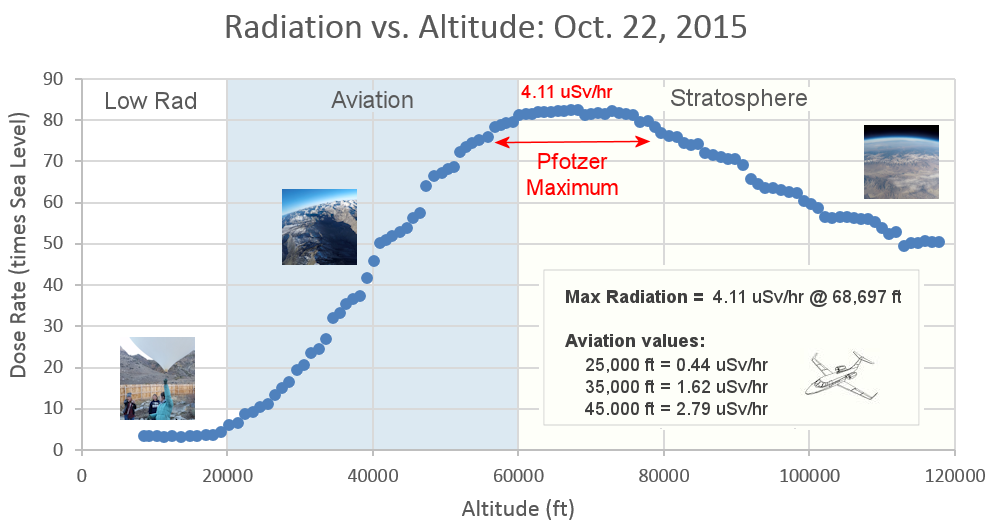
Sept. 20, 2016: Readers, thank you for your patience while we continue to develop this new section of Spaceweather.com. We've been working to streamline our data reduction, allowing us to post results from balloon flights much more rapidly, and we have developed a new data product, shown here:

This plot displays radiation measurements not only in the stratosphere, but also at aviation altitudes. Dose rates are expessed as multiples of sea level. For instance, we see that boarding a plane that flies at 25,000 feet exposes passengers to dose rates ~10x higher than sea level. At 40,000 feet, the multiplier is closer to 50x. These measurements are made by our usual cosmic ray payload as it passes through aviation altitudes en route to the stratosphere over California.
What is this all about? Approximately once a week, Spaceweather.com and the students of Earth to Sky Calculus fly space weather balloons to the stratosphere over California. These balloons are equipped with radiation sensors that detect cosmic rays, a surprisingly "down to Earth" form of space weather. Cosmic rays can seed clouds, trigger lightning, and penetrate commercial airplanes. Furthermore, there are studies ( #1, #2, #3, #4) linking cosmic rays with cardiac arrhythmias and sudden cardiac death in the general population. Our latest measurements show that cosmic rays are intensifying, with an increase of more than 12% since 2015:

Why are cosmic rays intensifying? The main reason is the sun. Solar storm clouds such as coronal mass ejections (CMEs) sweep aside cosmic rays when they pass by Earth. During Solar Maximum, CMEs are abundant and cosmic rays are held at bay. Now, however, the solar cycle is swinging toward Solar Minimum, allowing cosmic rays to return. Another reason could be the weakening of Earth's magnetic field, which helps protect us from deep-space radiation.
The radiation sensors onboard our helium balloons detect X-rays and gamma-rays in the energy range 10 keV to 20 MeV. These energies span the range of medical X-ray machines and airport security scanners.
The data points in the graph above correspond to the peak of the Reneger-Pfotzer maximum, which lies about 67,000 feet above central California. When cosmic rays crash into Earth's atmosphere, they produce a spray of secondary particles that is most intense at the entrance to the stratosphere. Physicists Eric Reneger and Georg Pfotzer discovered the maximum using balloons in the 1930s and it is what we are measuring today.