'CANYON OF FIRE' OPENS, SPITS A CME TOWARD EARTH: Yesterday, Nov. 5th, a filament of magnetism in the sun's northern hemisphere became unstable and erupted. The blast split the sun's atmosphere, hurling a CME into space and creating a "canyon of fire," shown here in a movie recorded by the Solar Dynamics Observatory:

The glowing walls of the canyon trace the original channel where the filament was suspended by magnetic forces above the sun's surface. From end to end, the structure stretches more than 200,000 km--a real Grand Canyon.
Fragments of the exploding filament formed the core of a CME that raced away from the sun faster than a million mph: movie. NOAA analysts have modeled the trajectory of the CME and concluded that it will probably strike Earth's magnetic field on Nov. 8th. The impact could spark G1-class geomagnetic storms and auroras at high latitudes. Free: Aurora Alerts


AIRGLOW IN THE POLAR NIGHT: "Polar night is coming to the subarctic," reports Mia Stålnacke of Kiruna, Sweden, just inside the Arctic Circle. "The sun set at 2:36 p.m. yesterday and at around 7:30 p.m. I shot this."

Stålnacke's long exposure captured not only the Milky Way looming over Kiruna, but also a beautiful splash of green.
Inside the Arctic Circle, green is normally a sign of geomagnetic activity--that is, the aurora borealis. "But this was no aurora," she says. "It's airglow."
Airglow is a chemical reaction involving oxygen in the upper atmosphere driven in part by solar ultraviolet radiation and cosmic rays. Visibility waxes and wanes with conditions such as pressure and temperature in the rarified air more than 90 km above Earth's surface. Gravity waves traveling up from the planet below impress the verdant glow with a dramatic rippling structure.
Dark nights with a new or thin crescent Moon are the best times to catch a glimpse of airglow. Often, the glow is dim and pale to the naked eye, revealing its green color only to the lens of cameras set for Milky Way-length exposures. Seeing airglow above the Arctic Circle is even more challenging as it is frequently overwhelmed by the brighter glow of auroras. Stålnacke picked a rare night when auroras were absent. As her photo shows, however, the polar night is never truly free of wonders.
Realtime Airglow Photo Gallery
FLIGHT OF THE SPACE PICKLE: Did you know that cosmic radiation in Earth's atmosphere is increasing? It's true. These and other findings of the Earth to Sky Calculus ballooning program are funded not by government grants or corporate donations. Instead, we rely on crowdfunding. Hence, the flight of the space pickle:
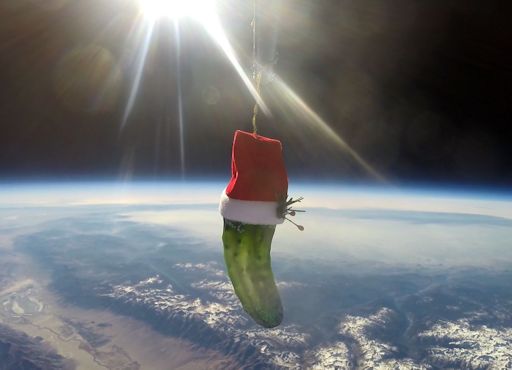
To raise funds for their ongoing research, Spaceweather.com and the students of Earth to Sky Calculus flew two dozen Christmas pickles to the stratosphere. On Nov. 5th, the glass gherkins ascended to an altitude of 111,900 feet, experiencing temperatures as low as -55 C and cosmic ray dose rates more than 100x Earth normal.
You can have one for your own tree. Price: $49.95. All proceeds are used to support cutting-edge student research. The space pickle and other edge of space gifts may be found in the Earth to Sky Store.
Realtime Space Weather Photo Gallery