ARCTIC AURORAS NOW: Bright auroras are dancing around the Arctic Circle on Nov. 11-12 as Earth moves deeper into a stream of high-speed solar wind. They are visible in some places despite the glare of a waxing supermoon. Watch the light show live from Sweden.
UN-IDENTIFIED CLOUD OVER SWEDEN: "Massive auroras and an unidentified object are dancing in the sky above Abisko National Park," reports Chad Blakley of Abisko, Sweden. "Our group of eight lucky aurora watchers were out in the park enjoying the display when something very odd appeared in the sky–a luminous crescent-shaped cloud with what appears to be some sort of a flowing, cloud like tail." The park's webcam captured this image of the cloud:

"At first I thought the object was lens flare produced by the bright Moon, but the object has moved from one area of the sky to another in four sequential photographs captured over a 20 minute timeframe," adds Blakley. "Seeing this incredible phenomenon share the sky with strong auroras has truly been a once in a lifetime event for our guests."
The cloud resembles a rocket fuel dump. Readers, if you think you know what this is, tell us.
THE BIGGEST FULL MOON IN ALMOST 70 YEARS: On Monday night, Nov. 14th, there's going to be a full Moon--the biggest and brightest in almost 70 years. Members of the press are calling it a "supermoon." The scientific term is "perigee Moon." These terms mean the same thing: The Moon is going to be as much as 14% bigger and 30% brighter than lesser moons we have seen in the past.
"The last time we had such a close full Moon was January 26, 1948," says Geoff Chester of the US Naval Observatory, "and it won't happen again until November 25, 2034."

Full moons vary in size because the Moon's orbit is not a circle, it's an ellipse. One side of the Moon's orbit (perigee) is 50,000 km closer to Earth than the other side (apogee): diagram. This Monday's Moon becomes full about 2 hours away from perigee, a coincidence that makes it remarkable.

But will we be able to tell the difference ... just by looking? A 30% difference in brightness can easily be masked by clouds or the competing glare of urban lights. Also, there are no rulers floating in the sky to measure lunar diameters. Hanging high overhead with no reference points to provide a sense of scale, one full Moon looks much like any other.
"I think that the hype over the term 'supermoon' is a bit overblown," says Chester. "In my book every full Moon has something to offer!"
To get the most out of Monday's apparition, Chester makes this recommendation: "Try to catch the Moon just as it is rising." A perigee Moon magnified by the Moon Illusion could look super, indeed.
Realtime Space Weather Photo Gallery
FLIGHT OF THE SPACE PICKLE: Did you know that cosmic radiation in Earth's atmosphere is increasing? It's true. These and other findings of the Earth to Sky Calculus ballooning program are funded not by government grants or corporate donations. Instead, we rely on crowdfunding. Hence, the flight of the space pickle:
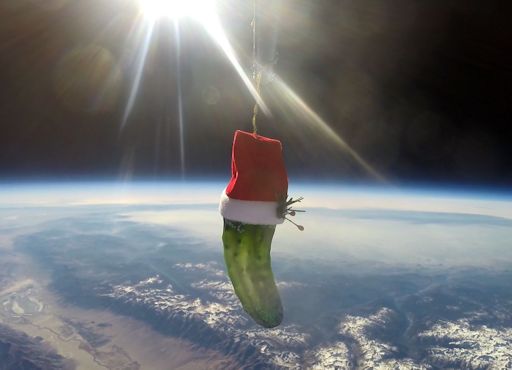
To raise funds for their ongoing research, Spaceweather.com and the students of Earth to Sky Calculus flew two dozen Christmas pickles to the stratosphere. On Nov. 5th, the glass gherkins ascended to an altitude of 111,900 feet, experiencing temperatures as low as -55 C and cosmic ray dose rates more than 100x Earth normal.
You can have one for your own tree. Price: $49.95. All proceeds are used to support cutting-edge student research. The space pickle and other edge of space gifts may be found in the Earth to Sky Store.