CHANCE OF GEOMAGNETIC STORMS: For the 3rd day in a row, Earth is passing through a stream of fast-moving solar wind. Minor G1-class geomagnetic storms are possible on Nov. 14th. The visibility of auroras, however, will be reduced by the glare of the supermoon. Browse: aurora photo gallery.

THE BIGGEST FULL MOON IN ALMOST 70 YEARS: Today's full Moon is the biggest and brightest in almost 70 years. The best time to look in North America is before sunrise on Monday morning, while in Europe the best time is after sunset on the same day.
"The last time we had such a close full Moon was January 26, 1948," says Geoff Chester of the US Naval Observatory, "and it won't happen again until November 25, 2034."
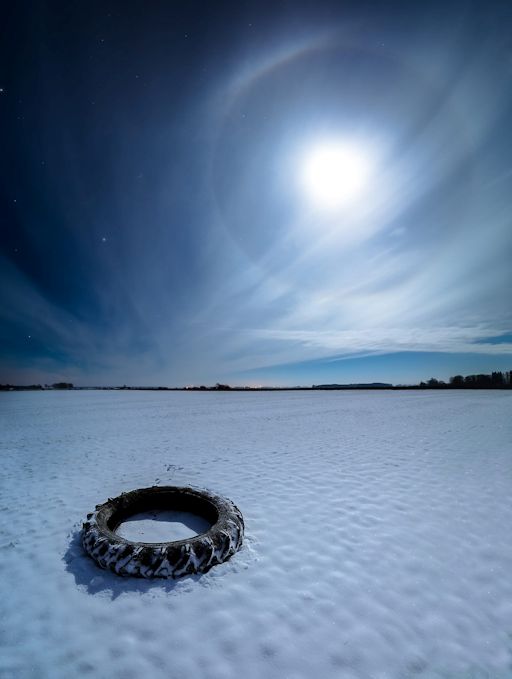
The supermoon and an ice halo, photographed by Tadas Janušonis of Vabalninkas, Lithuania.
Full moons vary in size because the Moon's orbit is not a circle, it's an ellipse: diagram. One side of the Moon's orbit, called "perigee," is 50,000 km closer to Earth than the other side, "apogee." This Monday's "supermoon" becomes full about 2 hours away from perigee, a coincidence that makes it as much as 14% bigger and 30% brighter than lesser moons we have seen in the past.

But will we be able to tell the difference ... just by looking? A 30% difference in brightness can easily be masked by clouds or the glare of urban lights. Also, there are no rulers floating in the sky to measure lunar diameters. Hanging high overhead with no reference points to provide a sense of scale, one full Moon looks much like any other.
"I think that the hype over the term 'supermoon' is a bit overblown," says Chester. "In my book every full Moon has something to offer!"
To get the most out of Monday's apparition, try to catch the Moon just as it is rising or setting. This will activate the Moon Illusion and make the perigee Moon of Nov. 14th look super, indeed.
Realtime Space Weather Photo Gallery
ROCKET PHOTOBOMBS AURORA OUTBURST: On Friday night in Sweden, aurora tour guide Oliver Wright led a group of 8 under the starry skies of Abisko National Park hoping for a glimpse of the aurora borealis. "Suddenly," says Wright, "one of the guests shouted 'what's that?' I grabbed my binoculars and saw this amazing crescent-shaped thing moving slowly across the sky." It was not the aurora borealis:
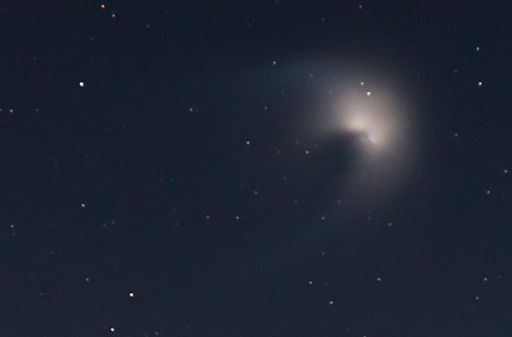
"I had never seen anything like it," says Wright, "so I called Chad Blakley of Lights over Lapland, and he confirmed that his live webcam saw it too." A four-frame animation shows it moving slowly across the sky for more than 20 minutes.
What was it? Mystery solved: Earlier in the day, an Atlas V rocket blasted off from Vandenberg Air Force Base in California carrying the Worldview 4 satellite to orbit. Later, the rocket's Centaur upper stage vented its excess fuel, creating the ghostly cloud over Sweden.
For Wright and his guests, the show was far from over. "A huge aurora started to develop around the Moon and became a magnificent corona above our heads," he says. This is a 1/2 second exposure:
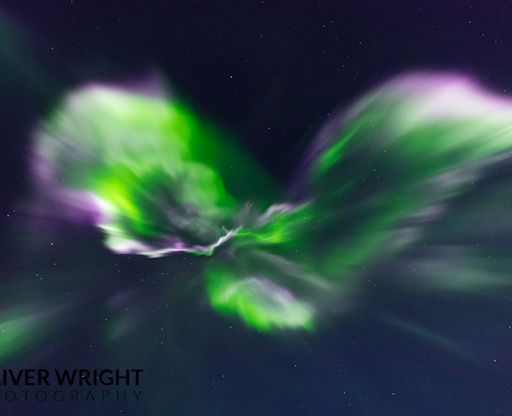
"It was moving super fast--the fastest corona I've seen in 3 years of guiding," says Wright. "In the end we had some super happy guests and a super happy guide!"