CHANCE OF MINOR STORMS ON NOV. 19TH: A minor solar wind stream is expected to buffet Earth's magnetic field on Nov. 19th. This could cause geomagnetic activity and auroras around the Arctic Circle. A live aurora webcam is monitoring the sky over Sweden's Abisko National Park. Watch now!
BIG CORONAL HOLE: A large hole in the sun's atmosphere is rotating into view over the sun's northeastern limb. NASA's Solar Dynamics Observatory photographed the structure on Nov. 18th:

This is a "coronal hole"--a region in the sun's atmosphere where the magnetic field peels back and allows solar wind to escape. It is too soon to say whether the emerging stream of solar wind will hit Earth head on when it reaches our planet next week. We will know more in the days ahead as the hole turns toward us to reveal its full dimensions and internal structure. Stay tuned for updates. Free: Aurora Alerts.
SUNSPOT CYCLE AT LOWEST LEVEL IN 5 YEARS: The sun has looked remarkably blank lately, with few dark cores interrupting the featureless solar disk. This is a sign that Solar Minimum is coming. Indeed, sunspot counts have just reached their lowest level since 2011. With respect to the sunspot cycle, you are here:
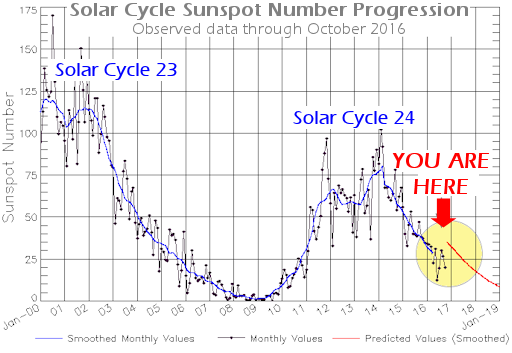
The solar cycle is like a pendulum, swinging back and forth between periods of high and low sunspot number every 11 years. These data from NOAA show that the pendulum is swinging toward low sunspot numbers even faster than expected. (The red line is the forecast; black dots are actual measurements.). Given the current progression, forecasters expect the cycle to bottom out with a deep Solar Minimum in 2019-2020.
Solar Minimum is widely misunderstood. Many people think it brings a period of dull quiet. In fact, space weather changes in interesting ways. For instance, as the extreme ultraviolet output of the sun decreases, the upper atmosphere of Earth cools and collapses. This allows space junk to accumulate around our planet. Also, the heliosphere shrinks, bringing interstellar space closer to Earth; galactic cosmic rays penetrate the inner solar system and our atmosphere with relative ease. (More on this below.) Meanwhile, geomagnetic storms and auroras will continue--caused mainly by solar wind streams instead of CMEs. Indeed, Solar Minimum is coming, but it won't be dull.
COSMIC RAYS CONTINUE TO INTENSIFY: As the sunspot cycle declines, we expect cosmic rays to increase. Is this actually happening? The answer is "yes." Spaceweather.com and the students of Earth to Sky Calculus have been monitoring radiation levels in the stratosphere with frequent high-altitude balloon flights over California. Here are the latest results, current as of Nov. 11, 2016:

Data show that cosmic ray levels are intensifying with an 11% increase since March 2015.
Cosmic rays are high-energy photons and subatomic particles accelerated in our direction by distant supernovas and other violent events in the Milky Way. Usually, cosmic rays are held at bay by the sun's magnetic field, which envelops and protects all the planets in the Solar System. But the sun's magnetic shield is weakening as the solar cycle shifts from Solar Max to Solar Minimum. As the sunspot cycle goes down, cosmic rays go up.
The sensors we send to the stratosphere measure X-rays and gamma-rays which are produced by the crash of primary cosmic rays into Earth's atmosphere. In this way we are able to track increasing levels of radiation. The increase is expected to continue for years to come as solar activity plunges toward a deep Solar Minimum in 2019-2020.
Recently, we have expanded the scope of our measurements beyond California with launch sites in three continents: North America, South America and soon above the Arctic Circle in Europe. This Intercontinental Space Weather Balloon Network will allow us to probe the variable protection we receive from Earth's magnetic field and atmosphere as a function of location around the globe.
EDGE OF SPACE CHRISTMAS ORNAMENTS: Would you like to hang something truly far out from your Christmas Tree this year? We offer for your consideration the Apollo 8 Christmas ornament. The ceramic disk shows an iconic photo from the Apollo program: Earth rising above the Moon as seen by Apollo 8 astronauts on Christmas Eve 1968. The students of Earth to Sky Calculus recently flew eight of these to the edge of space:

You can have one for $49.95. Each ornament comes with a Christmas card showing your ornament in the stratosphere and telling the story of its flight.
The cosmic ray research of Spaceweather.com and Earth to Sky Calculus is completely crowd-funded. Everyone who sponsors a balloon flight or buys an item from the Earth to Sky store contributes to this important body of knowledge. Thanks!
Realtime Space Weather Photo Gallery