CHANCE OF MINOR STORMS ON NOV. 19TH: A minor solar wind stream is expected to buffet Earth's magnetic field on Nov. 19th. This could cause geomagnetic activity and auroras around the Arctic Circle. Free: Aurora Alerts.
RETURN OF THE BIG CORONAL HOLE: At the end of October, a hole in the sun's atmosphere lashed Earth's magnetic field with solar wind, sparking moderately-strong geomagnetic storms and almost a full week of Arctic auroras. News flash: It's back. The same "coronal hole" is turning toward Earth again. NASA's Solar Dynamics Observatory photographed the structure on Nov. 19th:
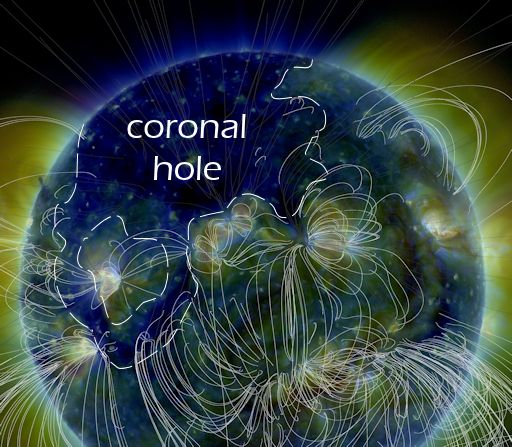
Coronal holes are regions in the sun's atmosphere where the magnetic field peels back and allows solar wind to escape. Since our last encounter with this hole in late October it has been transiting the farside of the sun, carried around by the sun's 27-day rotation. Now that it is back we can see that the hole is not quite as large as it was a month ago--but it is still impressive, covering almost 1/3rd of the visible solar disk.
NOAA forecasters expect the leading edge of the emerging solar wind stream to reach Earth on Nov. 22nd, bringing with it a chance of G1-class geomagnetic storms. Stay tuned! Free: Aurora Alerts.

TAIKONAUTS RETURN TO EARTH: Chinese astronauts (taikonauts) Jing Haipeng and Chen Dong are back on Earth. They've just finished a month-long mission to China's new space station, the Tiangong-2, doubling their countries' record for time in space. Observing from Taipei, Taiwan, amateur astronomer Hanjie Tan photographed their departure from the space station on Nov. 17th:
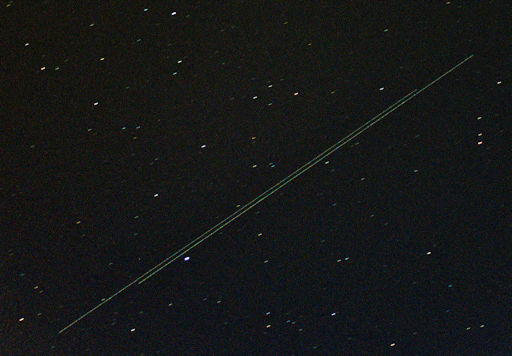
"This picture shows the taikonauts leaving the Tiangong-2 onboard their Shenzhou-11 spacecraft," says Tan. "They had just separated at the time I took this 20 second exposure."
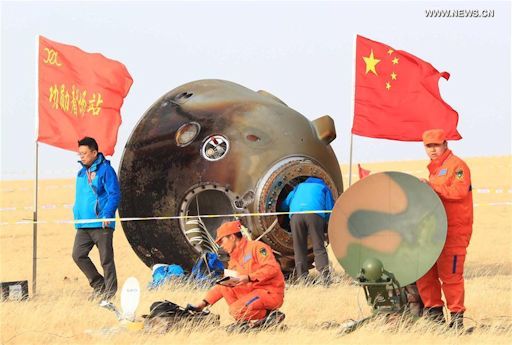
Less than two days after Tan witnessed the split, Haipeng and Dong parachuted back to Earth, touching down in inner Mongolia. Their landing capsule carried the results of many experiments including microbes grown in orbit, vegetables cultivated in a prototype space garden, and cocoons spun by silkworms. The latter is an experiment designed and built by Hong Kong middle school students; cocoons made in space will be compared to those spun by silkworms on the ground.
Tiangong 2 is expected to remain in orbit for at least two years, with more visits from taikonauts and automated supply craft in the offing. Within a few years, China plans to start launching modules for a much larger Mir-class space station slated for completion in the 2020s.
Although the new Chinese station is not as big and bright as its older cousin the ISS, it is still visible to the naked eye. See for yourself! Tiangong 2 flyby predictions may be found at Heavens Above.
Realtime Space Weather Photo Gallery
FLIGHT OF THE SPACE PICKLE: The ballooning program of Earth to Sky Calculus is funded not by government grants or corporate donations. Instead, we rely on crowdfunding. Hence, the flight of the space pickle:
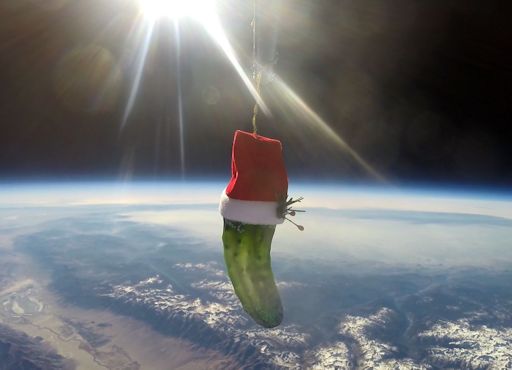
To raise funds for their ongoing research, Spaceweather.com and the students of Earth to Sky Calculus flew two dozen Christmas pickles to the stratosphere. On Nov. 5th, the glass gherkins ascended to an altitude of 111,900 feet, experiencing temperatures as low as -55 C and cosmic ray dose rates more than 100x Earth normal.
You can have one for your own tree. Price: $49.95. All proceeds are used to support cutting-edge student research. The space pickle and other edge of space gifts may be found in the Earth to Sky Store.