RETURN OF THE BIG CORONAL HOLE: At the end of October, a hole in the sun's atmosphere lashed Earth's magnetic field with solar wind, sparking moderately-strong geomagnetic storms and almost a full week of Arctic auroras. News flash: It's back. The same "coronal hole" is turning toward Earth again. NASA's Solar Dynamics Observatory photographed the structure on Nov. 20th:
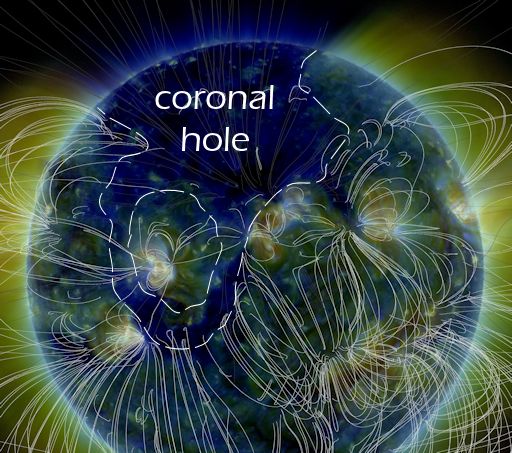
Coronal holes are regions in the sun's atmosphere where the magnetic field peels back and allows solar wind to escape. Since our last encounter with this hole in late October it has been transiting the farside of the sun, carried around by the sun's 27-day rotation. Now that it is back we can see that the hole is not quite as large as it was a month ago--but it is still impressive, covering more than 1/4th of the visible solar disk.
NOAA forecasters expect the leading edge of the emerging solar wind stream to reach Earth late on Nov. 22nd, bringing with it a chance of G1-class geomagnetic storms on Nov. 23rd. Free: Aurora Alerts.

THANKSGIVING SKIES: Thanksgiving is the biggest travel holiday of the year in the United States. Millions of people board airplanes and fly long hours to visit friends and family. Dreading the trip? Think of it as a sky watching opportunity. There are some things you can see only through the window of an airplane, like this:
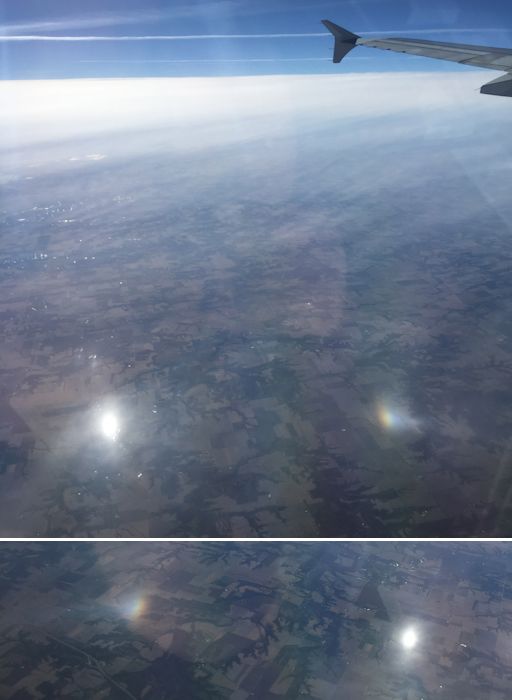
Chris Dalla Piazza took the picture on Nov. 9th while flying over Utah. "At first I thought the bright white spot was some kind of internal reflection in the window," says Piazza. "But then I saw that it was flanked by rainbow-colored splashes of light. It was not a reflection."
It was a subsun. Atmospheric optics expert Les Cowley explains : "Look down from the sunny side of an aircraft and you will often see a dazzling reflection of the sun in the clouds. This is a subsun, formed by millions of plate shaped ice crystals acting as mirrors."
"We were indeed flying above a thin layer of icy cirrus clouds," says Piazza.
Ice crystals in those clouds created not only a subsun, but also a pair of sub-sundogs. Many readers have seen regular sundogs flanking the actual sun. Those are formed by an even number of reflections inside ice crystals. An odd number of reflections makes the sub-sundog."
In this article, Cowley describes even more things you can see through the airplane window. Happy Thanksgiving!
Realtime Space Weather Photo Gallery
EDGE OF SPACE CHRISTMAS ORNAMENTS: To support their ballooning program, the students of Earth to Sky Calculus have flown some special Christmas ornaments to the edge of space. The ceramic disks show the silhouette of Santa and his reindeer backlit by the supermoon:

On Nov. 5th, Earth to Sky's cosmic ray payload carried 10 of these ceramic disks to an altitude of 111,900 feet. En route, they experienced temperatures as low as -55 C and cosmic ray dose rates more than 100x Earth normal. After the balloon exploded, the payload parachuted back to Earth, landing in the Eureka Valley at the edge of Death Valley National Park. All 10 ornaments returned intact.
You can have one for your own tree. Price: $49.95. All proceeds are used to support cutting-edge student research. More edge of space Christmas ornaments may be found in the Earth to Sky Store.