SLIGHT CHANCE OF FLARES: NOAA forecasters say there is a 20% chance of M-class solar flares on Dec. 1st. The source, sunspot AR2615, is facing Earth so any eruptions would be geoeffective. Likely effects include minor radio blackouts on the sunlit side of our planet. Free: Solar flare alerts.
REFLECTION RAINBOW: Spaceweather.com reader Chris Erikson was driving to work yesterday when he saw something strange. It was a rainy day on the Columbia River Gorge near the Oregon-Washington border, and a beautiful double rainbow arced across the sky. Suddenly, as passed the riverbank, another rainbow cut across the double 'bow. "I've never seen such a thing before," says Erikson, who snapped this picture through the front windshield:

This is called a "reflection rainbow." To understand where it comes from, remember how normal rainbows form: Sunlight bounces in and out of falling raindrops. Those raindrops act like tiny prisms, spreading sunbeams into their constituent colors. Reflection rainbows form in the same way, except the source of light is not the sun; it's the reflection of the sun from a body of water.
"The sun must have been reflecting from the Columbia River, which was only 200 feet to my left," says Erikson. "Here's a map showing where I was."

Rainbows come in a variety of forms. The reflection rainbow Erikson photographed is just one of many you can see if you are alert for the unusual. Start looking here.
Realtime Space Weather Photo Gallery
MESOSPHERIC BORE (IT'S NOT WHAT YOU THINK): This month, a lot is happening in the mesosphere. The mesosphere is a layer of Earth's atmosphere above the stratosphere; it is the realm of sprites, noctilucent clouds (NLCs), and airglow. Starting on Nov. 17th, NASA's AIM spacecraft spotted bright noctilucent clouds forming in the mesosphere above Antarctica. Then, in an apparently unrelated development on Nov. 24th, the normal dome of airglow over China split in two. Xiao Shuai photographed the event from Mount Balang in Sichuan:

This is called a "mesospheric bore"--and not because it's dull. A bore is a type of atmospheric wave with deep ripples at its leading edge. Indeed, you can see the ripples in Shuai's photo separating the zone of airglow from clear sky.
Bores fall into the category of "gravity waves"—so called because gravity acts as the restoring force essential to wave motion. Analogy: Boats in water. When a boat goes tearing across a lake, water in front of the boat is pushed upward. Gravity pulls the water back down again and this sets up a wave.
In this case, instead of water, rarefied air is the medium through which the wave propagates. The sudden boundary in the airglow layer is probably akin to a hydraulic jump. But what created the disturbance in the first place? (What is the 'boat'?) No one knows.
"There may be updates in the coming days as scientists from NASA and the Chinese Academy of Science check data from satellites to learn more about this event," says Jeff Dai, who has been helping Xiao Shuai process and communicate his extraordinary images. "Also, we encourage other photographers from Thailand, Myanmar, Bangladesh and India to submit their images of the wave."
Realtime Space Weather Photo Gallery
BUY A TICKET TO THE EDGE OF SPACE: Christmas shopping for a young scientist? Consider this: For the holiday season only, we're reducing the cost of payload space on Earth to Sky Calculus balloons from $500 to only $299.95. Buy an edge of space gift certificate before Dec. 25th and your student can send an experiment, photo, or keepsake item to the stratosphere, completely supported by an Earth to Sky Calculus launch and recovery team.
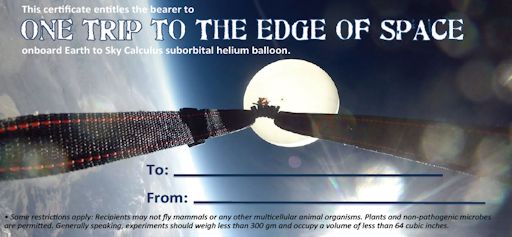
This is not only a great Christmas gift, but also a good kickstarter for science fair projects. Experiments will be flown and returned along with video footage, GPS tracking, temperature, pressure, altimetry and radiation data.
To take advantage of the discounted rate, payment must be received before Dec. 25th. However, the flight can take place at any time in the next 12 months.
Conditions: No mammals. Plants and non-pathogenic microbes are allowed. Generally speaking, experiments should weigh less than ~300 grams and occupy a volume less than ~64 cubic inches. A Skype brainstorming session is included with each certificate. Dr. Tony Phillips and other members of the Earth to Sky team will chat with students to help them craft an experiment that will work in the harsh environment of the stratosphere.
More edge of space Christmas gifts may be found in the Earth to Sky Store.