SATURDAY NIGHT LIGHTS: Venus and the Moon are doing it again--putting on a show in the sunset sky. Look for them in the southwest just after sundown. If possible, go outside before the sky fades completely black. For reasons no scientist can explain, these two heavenly bodies are especially beautiful when surrounded by twilight blue. Sky maps: Dec. 2nd, 3rd.


WATCH OUT FOR THE DA VINCI GLOW: If you go outside tonight to witness the meeting of Venus and the crescent Moon, pay special attention to the Moon. Cradled between the arms of the slender crescent is a display of light and shadow that puzzled sky watchers for thousands of years--until Leonardo da Vinci figured it out. It's the "Da Vinci glow," also known as Earthshine:
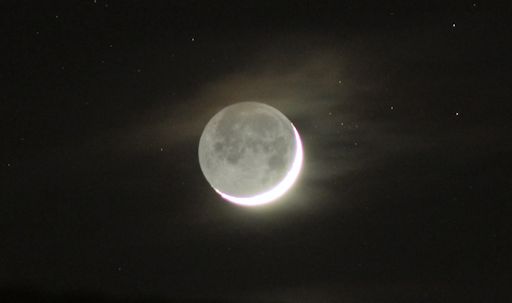
Richard Sears of Merced, California, took the picture last night. "I was getting ready for the Venus-Moon conjunction," he says. "The Earthshine was gorgeous."
For much of human history, people marveled at the faint image of the full Moon inside the arms of the crescent. Where did it come from? No one knew until the 16th century when Leonardo figured it out. He realized that dark lunar terrain was being illuminated by sunlight reflected from Earth.
Visualizing this in the 1500s required a wild kind of imagination. No one had ever been to the Moon and looked "up" at Earth. Most people didn't even know that Earth orbited the sun. Copernicus' sun-centered theory of the solar system wasn't published until 1543, twenty-four years after Leonardo died.
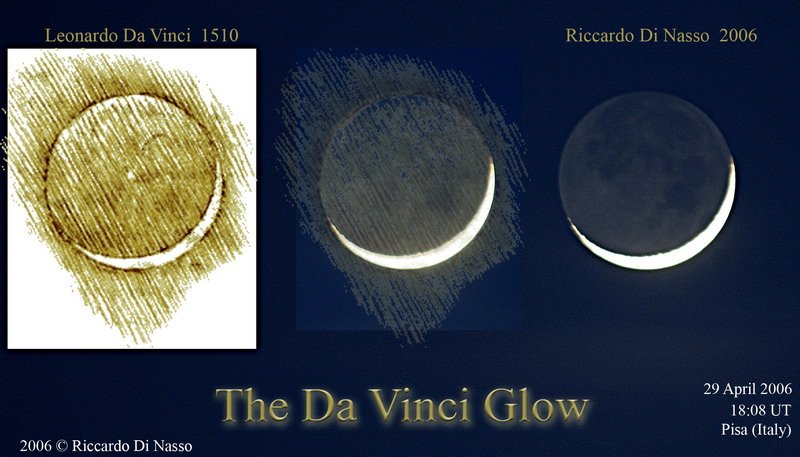
Above: Da Vinci's sketch of Earthshine in 1510 vs. Italian astronomer Riccardo Di Nasso's photo of Earthshine in 2006.
Wild imagination, however, was one thing Leonardo had in abundance. His notebooks are filled with sketches of flying machines, army tanks, scuba gear and other fantastic devices centuries ahead of their time.
In Leonardo's Codex Leicester, circa 1510, there is a page entitled "Of the Moon: No Solid Body is Lighter than Air." He states his belief that the "ghostly glow" is due to sunlight bouncing off Earth's oceans and, in turn, hitting the Moon. 500 years later, we know that Earth's clouds (not oceans) do most of the reflecting; but that is a quibble. Leonardo understood the basics well enough.
Go outside tonight and look to the sky. The Da Vinci Glow is waiting....
Realtime Space Weather Photo Gallery
LARGE CORONAL HOLE TURNING TOWARD EARTH: A large hole in the sun's atmosphere has formed and it is turning toward Earth. NASA's Solar Dynamics Observatory took this extreme ultraviolet image of the structure on Dec. 3rd:

This is a "coronal hole"--a region where the sun's magnetic field has opened up, allowing solar wind to escape. A stream of solar wind emerging from this coronal hole could reach Earth as early as Dec. 7th and influence the near-space environment of our planet for several days. G1-class geomagnetic storms and high-latitude auroras are possible when the solar wind arrives.

Note: The forecast will improve in the days ahead as the hole rotates into better view, revealing its form and dimensions. Stay tuned!
FAR OUT STOCKING STUFFER: It's out of this world: the Sirius Space Pendant. To raise money for their space weather ballooning program, the students of Earth to Sky Calculus have flown 3 dozen pendants to the edge of space–and you can have one for $69.95. The pendant comes with a greeting card showing the jewelry in flight and certifying that it has been to the stratosphere and back again.
The pendants flew to the edge of space on Nov. 20, 2016, alongside an array of cosmic radiation sensors. (We're reducing the data now!) After the balloon exploded, the payload parachuted back to Earth, landing in the snowy San Antonio mountains north of Tonopah, Nevada, where a student team recovered it on Nov. 22nd.
The research of Earth to Sky Calculus is not supported by government grants or corporate donations. Instead, we are entirely crowd-funded. Proceeds from the sale of items like the Sirius Pendant go right back into cutting-edge student research. More edge of space Christmas gifts may be found in the Earth to Sky Store.