SOLAR WIND SPARKS AURORAS: Earth is now fully inside a stream of solar wind flowing from a large coronal hole on the sun. The buffeting action of the stream is causing intermittent auroras around the Arctic Circle--some of them quite bright. "We had a fantastic display in northern Sweden," reports Oliver Wright, who sends this picture from Abisko National Park:


"This was an aurora storm within a storm," says Wright, who spent the evening guiding a group of sky watchers for Lights over Lapland. "We went out in 100% clouds, strong winds and blowing snow. Suddenly, the clouds parted and the guests got to see a full-on aurora storm."
The stream of solar wind powering these auroras is broad, and it could take Earth two or three days to cross it. Arctic observers should be alert for more lights on Dec.9th and 10th. Free: Aurora Alerts
GEMINID METEOR SHOWER: Canada's Meteor Orbit Radar (CMOR) is picking up echoes from the constellation Gemini. It's a sign that the annual Geminid meteor shower is underway. The bright pink "hot spot" in this CMOR sky map shows where Geminid meteoroids are hitting the atmosphere on Dec. 9th:

Geminid meteoroids are gravelly debris from "rock comet" 3200 Phaethon. They hit Earth's atmosphere traveling ~35 km/s (78,000 mph) and typically disintegrate about 80 km (50 miles) above Earth's surface. While many Geminids are faint, bright fireballs are not unusual.
At the moment, visible Geminid meteor rates are no more than a few per hour. Sightings will increase in the nights ahead as Earth plunges deeper into the debris zone of 3200 Phaethon. Forecasters expect peak rates to occur on Dec. 13-14 when observers in both hemispheres could see dozens of Geminids despite the glare of a bright full Moon. The best time to look is during the hours after local midnight. [sky map]
STUDENT SPECIAL: Is there a young scientist in your life? For Christmas, you can give them the gift of exploration. For the holiday season only, we're reducing the cost of payload space on Earth to Sky Calculus balloons from $500 to only $299.95. Buy an edge of space gift certificate before Dec. 25th and your student can send an experiment, photo, or keepsake item to the stratosphere, completely supported by an Earth to Sky Calculus launch and recovery team.
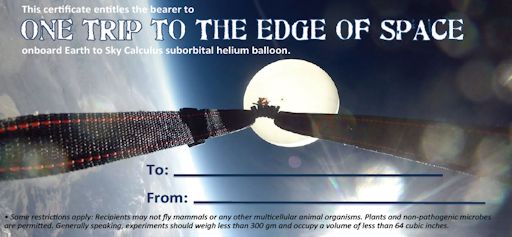
This is not only a great Christmas gift, but also a good kickstarter for science fair projects. Experiments will be flown and returned along with video footage, GPS tracking, temperature, pressure, altimetry and radiation data.
To take advantage of the discounted rate, payment must be received before Dec. 25th. However, the flight can take place at any time in the next 12 months. A Skype brainstorming session is included with each certificate. Dr. Tony Phillips and other members of the Earth to Sky team will chat with students to help them craft an experiment that will work in the harsh environment of the stratosphere.
More far out Christmas gifts may be found in the Earth to Sky Store. All proceeds support space weather research.
Realtime Space Weather Photo Gallery
Realtime Airglow Photo Gallery