EXITING THE SOLAR WIND STREAM: After four days inside, Earth is exiting a stream of solar wind that has been buffeting our planet's magnetic field. The glow of Arctic auroras should subside on Dec. 11-12 as the solar wind velocity falls. Browse: aurora sightings.
GEMINID METEORS vs. THE FULL MOON: The Geminid meteor shower peaks this week. Unfortunately, so does the full Moon. Lunar glare will be intense on Dec. 13th and 14th just as the shower climaxes. Bright moonlight will wipe out the normal profusion of faint Geminids, reducing meteor counts more than 5-fold. Now for the good news: Some Geminids are fireballs. Frankie Lucena of Puerto Rio photographed this one on Dec. 11th:

"The only meteors visible last night were the really bright ones," says Lucena. "The Moon will be getting brighter and brighter the next few nights, which probably means only fireballs will show up in my photos."
The object floating below the meteor is not a UFO. "It's a tethered aerostat radar system," explains Lucena. US Customs and Border Protection uses the moored helium balloon for low-level air and ground surveillance.
Geminid meteoroids are gravelly debris from "rock comet" 3200 Phaethon. They hit Earth's atmosphere traveling ~35 km/s (78,000 mph) and typically disintegrate about 80 km (50 miles) above Earth's surface. Because of the Geminids' rocky origin, big meteoroids and bright fireballs are not uncommon. Indeed, NASA's network of all-sky fireball cameras detected more than half a dozen over the USA on Dec. 11th--numbers that will increase as Earth approaches the heart of the debris stream later this week.
For observers in both hemispheres, the best time to look is during the hours between local midnight and sunrise on Wednesday, Dec. 14th. [sky map]

POLAR STRATOSPHERIC CLOUDS: The stratosphere above the Arctic Circle is getting cold ... very cold. That's the only way to explain these colorful clouds that materialized over Kiruna, Sweden, on Dec. 9th:

"Polar stratospheric clouds are back in the subarctic," reports photographer Mia Stålnacke. "They were brilliantly beautiful today."
Icy polar stratospheric clouds (PSCs) form in the lower stratosphere when temperatures drop to around -85ºC. That's how cold it has to be for ice crystals to form in the very dry stratosphere. High-altitude sunlight shining through tiny ice particles ~10µm across produce the characteristic bright iridescent colors.
"Once seen they are never forgotten," says atmospheric optics expert Les Cowley. "Polar stratospheric clouds have much more vivid colors than ordinary iridescent clouds, which are very much poor relations and seen frequently all over the world."
Once thought to be mere curiosities, some PSCs are now known to be associated with the destruction of ozone. Indeed, an ozone hole formed over the UK in Feb. 2016 following an outbreak of ozone-destroying Type 1 PSCs.
"Last winter we had these clouds almost daily for long periods of time," says Stålnacke. Arctic sky watchers are encouraged to be alert for more in the days ahead. The best time to look is just before sunrise or after sunset.
Realtime Space Weather Photo Gallery
STUDENT CHRISTMAS SPECIAL: Is there a young scientist in your life? For Christmas, you can give them the gift of exploration. For the holiday season only, we're reducing the cost of payload space on Earth to Sky Calculus balloons from $500 to only $299.95. Buy an edge of space gift certificate before Dec. 25th and your student can send an experiment, photo, or keepsake item to the stratosphere, completely supported by an Earth to Sky Calculus launch and recovery team.
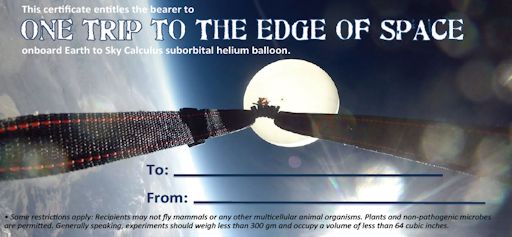
This is not only a great Christmas gift, but also a good kickstarter for science fair projects. Experiments will be flown and returned along with video footage, GPS tracking, temperature, pressure, altimetry and radiation data.
To take advantage of the discounted rate, payment must be received before Dec. 25th. However, the flight can take place at any time in the next 12 months. A Skype brainstorming session is included with each certificate. Dr. Tony Phillips and other members of the Earth to Sky team will chat with students to help them craft an experiment that will work in the harsh environment of the stratosphere.
More far out Christmas gifts may be found in the Earth to Sky Store. All proceeds support space weather research.
Realtime Airglow Photo Gallery