TONIGHT'S FULL MOON IS A PERIGEE MOON: If you think tonight's full Moon seems a bit bigger and brighter than usual, you're right. It's a "perigee Moon," about 14% bigger and 30% brighter than lesser full Moons we've seen earlier this year. The Moon's orbit is an ellipse with one side (perigee) about 50,000 km closer than the other (apogee): diagram. Perigee moons--a.k.a. "supermoons"--are not unusual. This is the third month in a row we've had one.


Photo credit: Charles Chiofar of Buckley, Washington. Dec. 12, 2016.
Realtime Space Weather Photo Gallery
GEMINID METEORS vs. THE FULL MOON: The Geminid meteor shower peaks this week. Unfortunately, so does the full Moon. Lunar glare will be intense on Dec. 13th and 14th just as the shower climaxes. Bright moonlight will wipe out the normal profusion of faint Geminids, reducing meteor counts more than 5-fold. Now for the good news: Some Geminids are moonbeaters. Eliot Herman photographed this Geminid fireball burning up above Tucson, Arizona, before sunrise on Dec. 13th:
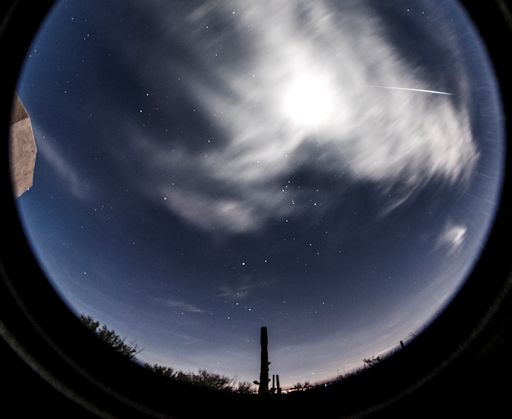
"The combination of moonlight and clouds made it difficult to see anything," says Herman, "yet this Geminid fireball was visible anyway. An easy catch!"
Geminid meteoroids are gravelly debris from "rock comet" 3200 Phaethon. They hit Earth's atmosphere traveling ~35 km/s (78,000 mph) and typically disintegrate about 80 km (50 miles) above Earth's surface. Because of the Geminids' rocky origin, big meteoroids and bright fireballs are not uncommon. Indeed, NASA's network of all-sky fireball cameras detected more than 50 over the USA on Dec. 12-13--numbers that will increase as Earth passes through the heart of the debris stream later tonight.
For observers in both hemispheres, the best time to look is during the hours between local midnight and sunrise on Wednesday, Dec. 14th. [sky map]

THIS CHRISTMAS GIFT HAS BEEN TO SPACE: To raise money for their space weather ballooning program, the students of Earth to Sky Calculus have flown 10 "Tree of Life" pendants to the edge of space. You can have one for $79.95. The limited edition pendant comes with a greeting card showing the jewelry in flight and certifying that it has been to the stratosphere and back again.
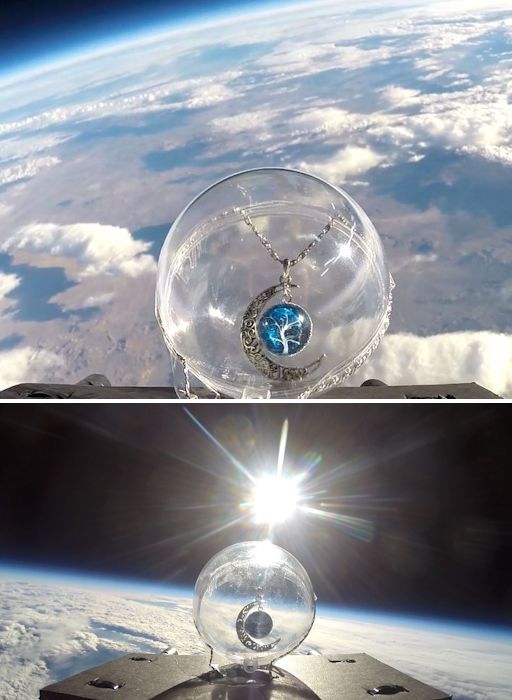
The pendants flew to the edge of space on Nov. 20, 2016, alongside an array of cosmic radiation sensors. During the flight, the sensors picked up the highest levels of radiation recorded so far during our 2 year monitoring program. After the balloon exploded, the payload parachuted back to Earth, landing in the snowy San Antonio mountains north of Tonopah, Nevada, where a student team recovered it on Nov. 22nd.
The research of Earth to Sky Calculus is not supported by government grants or corporate donations. Instead, we are entirely crowd-funded. Proceeds from the sale of items like the Space Pendant go right back into cutting-edge student research. More far out Christmas gifts may be found in the Earth to Sky Store.
Realtime Airglow Photo Gallery