SURFING THE NORTHERN LIGHTS: Australian surfing great Mick Fanning was recently caught riding the waves at Unstad beach in Lofoten, Norway. High overhead, a geomagnetic storm with towering green auroras was underway. Must-see images have just been published by several news outlets: #1, #2, #3.
MORE AURORAS POSSIBLE THIS WEEKEND: Surfers, mark your calendars. A solar wind stream is heading for earth and it could spark a new round of Arctic lights on Dec. 16th. The gaseous stream is flowing from a hole in the sun's atmosphere, shown here in a Dec. 14th image from NASA's Solar Dynamics Observatory:

This is called a "coronal hole"--a region in the sun's atmosphere where the magnetic field opens up and allows solar wind to escape. Some coronal holes are large, covering a majority of the solar disk. This one, however, is small, and the emerging stream is relatively narrow. Earth will probably remain inside the windy zone, dipping in and out, for little more than a day. Stay tuned for updates.
GEMINID METEORS MINGLE WITH MOONLIGHT: Some forecasters predicted the glaring full Moon of Dec. 13th would doom the Geminid meteor shower, reducing it to near invisibility. Bill Metallinos of Corfu, Greece, begs to disagree. "On Dec. 14th we saw some beautiful Geminids," he says. Indeed, here is the nightscape he recorded above Cape Drastis:
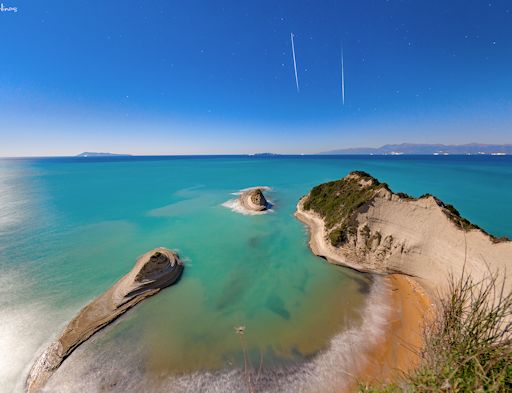
"These two Geminid were easy to see from the clay islets of Peroulades, Corfu," says Metallinos. "The landscape shines under the light of the Supermoon while the colors of water change because of the clay. The sediments are from lower Paleocene age 1-2 million years ago."
Geminid meteoroids are gravelly debris from "rock comet" 3200 Phaethon. They hit Earth's atmosphere traveling ~35 km/s (78,000 mph) and typically disintegrate about 80 km (50 miles) above Earth's surface. Because of the Geminids' rocky origin, big meteoroids and bright fireballs like the ones Metallinos photographed are not uncommon.
Today, Dec. 15th, Earth is exiting the heart of 3200 Phaethon's debris stream. The shower should remain active, albeit waning, for the next few nights. If you're out after dark, be alert for occasional fireballs in the moonlight. [sky map]

THIS CHRISTMAS ORNAMENT HAS BEEN TO SPACE: Would you like to hang something far out from your Christmas Tree? We offer for your consideration the Space Santa Christmas ornament. Using a helium balloon, the students of Earth to Sky Calculus flew a dozen of these to the edge of space, and you can have one for $49.95:

These ornaments have been on an adventure. En route to the stratosphere, they experienced temperatures as low as -55 C and cosmic ray dose rates more than 100x Earth normal. After the balloon exploded more than 117,000 feet high, the payload parachuted back to Earth, landing in the Eureka Valley at the edge of Death Valley National Park.
Each ornament comes with a Christmas card showing the ceramic disk in the stratosphere and telling the story of its flight.
The cosmic ray research of Spaceweather.com and Earth to Sky Calculus is completely crowd-funded. Everyone who sponsors a balloon flight or buys an item from the Earth to Sky store contributes to a growing body of knowledge about radiation in our planet's atmosphere.
Realtime Space Weather Photo Gallery
Realtime Airglow Photo Gallery