AURORAS FOR CHRISTMAS? Earth is about to enter a stream of fast-moving solar wind. G1-class geomagnetic storms are expected to begin on Dec. 21st with magnetic unrest continuing through Dec. 25th. Sky watchers around the Arctic Circle should be alert for Northern Lights.

The source of the solar wind is a gigantic hole in the sun's atmosphere, now directly facing Earth. NASA's Solar Dynamics Observatory photographed the structure, which covers nearly 1/3rd of the solar disk:

This is a "coronal hole"--a region in the sun's atmosphere where the magnetic field opens up and allows solar wind to escape. We've actually seen this coronal hole before--at least twice. It is rotating around with the sun, strobing Earth like a lighthouse every ~27 days. The last two times we experienced its solar wind (Oct. 25-28 and Nov. 23-26), G1- and G2-class magnetic storms sparked bright polar auroras. A repeat performance is likely in the week ahead.

ARCTIC LIGHT SHOW: What do you get when you mix moonlight, fog, and solar wind near the Arctic Circle? Photographer Göran Strand of Östersund, Sweden, provides the answer: "A lunar fogbow backlit by Northern Lights."

Strand took this picture on Dec.17th from the shore of Lake Storsjön, the 5th largest body of water in Sweden. A layer of fog hovering above the lake's surface intercepted rays of moonlight to form a lovely fogbow.
"Fogbows have been on my bucket list for quite some time," says Strand. "I've seen photos of them, but I've never seen one in real life until now."
Fogbows are close cousins of rainbows and they are formed in essentially the same way: light bounces in and out of water droplets to produce a luminous arc. The background glow of green auroras was caused by a minor stream of solar wind, which buffeted Earth's magnetic field over the weekend.
Realtime Space Weather Photo Gallery
STUDENT CHRISTMAS SPECIAL: Is there a young scientist in your life? For Christmas, give them the gift of exploration. For the holiday season only, we're reducing the cost of payload space on Earth to Sky Calculus balloons from $500 to only $299.95. Buy an edge of space gift certificate before Dec. 25th and you can send an experiment, photo, or keepsake item to the stratosphere, completely supported by an Earth to Sky Calculus launch and recovery team.
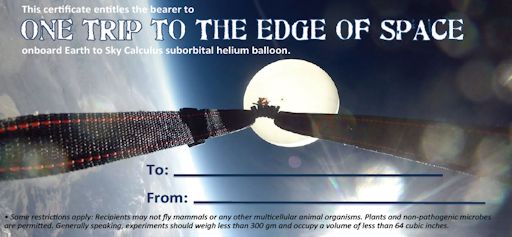
This is not only a great Christmas gift, but also a good kickstarter for science fair projects. Experiments will be flown and returned along with video footage, GPS tracking, temperature, pressure, altimetry and radiation data.
To take advantage of the discounted rate, payment must be received before Dec. 25th. However, the flight can take place at any time in the next 12 months. A Skype brainstorming session is included with each certificate. Dr. Tony Phillips and other members of the Earth to Sky team will chat with students to help them craft an experiment that will work in the harsh environment of the stratosphere.
More far out Christmas gifts may be found in the Earth to Sky Store. All proceeds support space weather research.
Realtime Airglow Photo Gallery