APPROACHING THE SOLAR WIND STREAM: Later today, Dec.20th, Earth is expected to enter a stream of solar wind flowing at high speed from a large hole in the sun's atmosphere. This could set in motion days of magnetic unrest around the poles. NOAA forecasters estimate a 60% chance of minor G1-class geomagnetic storms on Dec. 21st, increasing to 65% on Dec. 22nd. Stay tuned for Arctic auroras.


URSID METEOR SHOWER: Earth is passing through a filament of debris from comet 8P/Tuttle, source of the annual Ursid meteor shower. If forecasters are correct, the shower should peak on Dec. 22nd with 5 to 10 meteors per hour flying out of the constellation Ursa Minor (the Little Dipper). Eliot Herman photographed an early-arriving Ursid on Dec. 17th from Tucson, AZ:
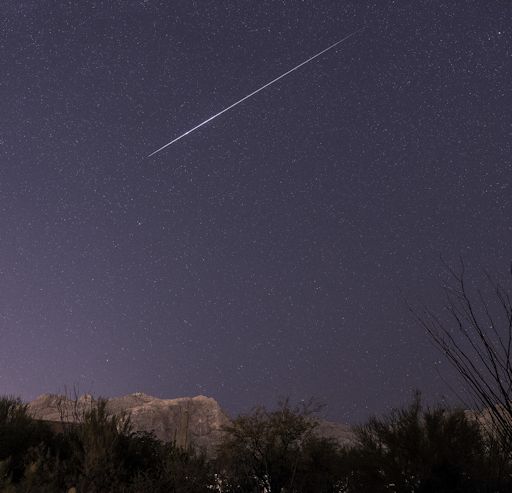
The most intense phase of the Ursid shower is brief, typically just 12 hours or so. The narrow 2016 peak is expected to arrive around 0900 UT (4 a.m. EST/ 1 a.m. PST) on Thursday morning--good timing for North America. Note: This is considered to be a minor shower. Nevertheless, outbursts of Ursids occasionally surprise observers with rates many times normal. Monitor the realtime meteor gallery for sightings.
ARCTIC LIGHT SHOW: What do you get when you mix moonlight, fog, and solar wind near the Arctic Circle? Photographer Göran Strand of Östersund, Sweden, provides the answer: "A lunar fogbow backlit by Northern Lights."

Strand took this picture on Dec.17th from the shore of Lake Storsjön, the 5th largest body of water in Sweden. A layer of fog hovering above the lake's surface intercepted rays of moonlight to form a lovely fogbow.
"Fogbows have been on my bucket list for quite some time," says Strand. "I've seen photos of them, but I've never seen one in real life until now."
Fogbows are close cousins of rainbows and they are formed in essentially the same way: light bounces in and out of water droplets to produce a luminous arc. The background glow of green auroras was caused by a minor stream of solar wind, which buffeted Earth's magnetic field over the weekend.
ORDER TODAY FOR CHRISTMAS DELIVERY: To raise money for their space weather ballooning program, the students of Earth to Sky Calculus have flown 10 "Tree of Life" pendants to the edge of space. You can have one for $79.95. The limited edition pendant comes with a greeting card showing the jewelry in flight and certifying that it has been to the stratosphere and back again.
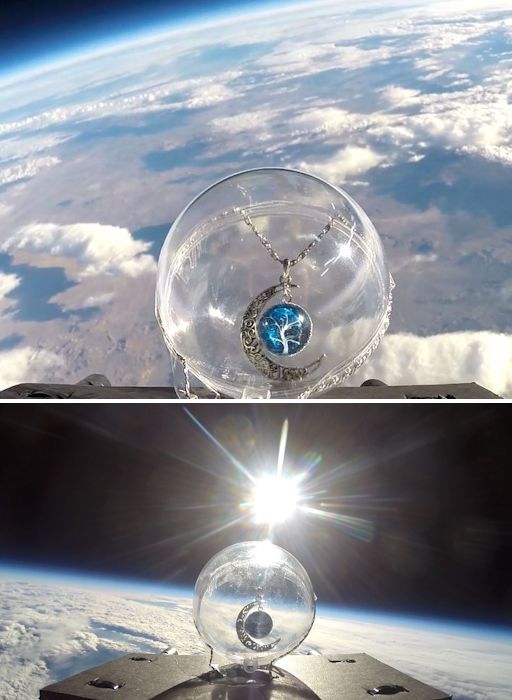
The pendants flew to the edge of space on Nov. 20, 2016, alongside an array of cosmic radiation sensors. During the flight, the sensors picked up the highest levels of radiation recorded so far during our 2 year monitoring program. After the balloon exploded, the payload parachuted back to Earth, landing in the snowy San Antonio mountains north of Tonopah, Nevada, where a student team recovered it on Nov. 22nd.
The research of Earth to Sky Calculus is not supported by government grants or corporate donations. Instead, we are entirely crowd-funded. Proceeds from the sale of items like the Space Pendant go right back into cutting-edge student research. More far out Christmas gifts may be found in the Earth to Sky Store.
Realtime Space Weather Photo Gallery
Realtime Airglow Photo Gallery