THE SOLAR WIND ON BOXING DAY: For the fifth day in a row, Earth is inside a stream of solar wind blowing out of a large hole in the sun's atmosphere. This is causing magnetic unrest and bright auroras around the poles. Wind speeds are expected to exceed 600 km/s for at least one more day, so Arctic sky watchers should remain alert for auroras on Dec. 26th. Free: Aurora Alerts.

I'M DREAMING OF A ... PINK CHRISTMAS? Christmas Day 2016 brought a fantastic display of auroras to the Arctic Circle. A great many of them were pink. James Helmericks sends this picture from the Colville River Delta in northern Alaska:
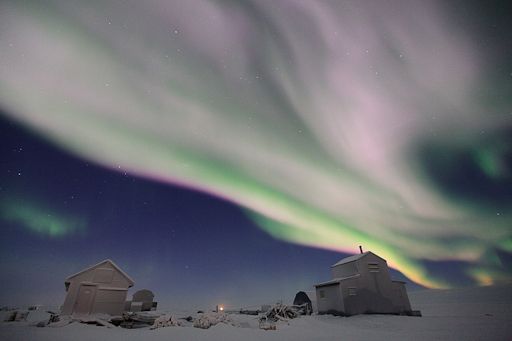
"This was the brightest pink display I have ever seen, at one time even giving the snow a pink tinge," he says.
The pink color is probably a sign of nitrogen. Most auroras are green--a verdant glow caused by energetic particles from space hitting oxygen atoms 100 km to 300 km above Earth's surface. Seldom-seen pink appears when the energetic particles descend lower than usual, striking nitrogen molecules at the 100 km level and below. Such deep-penetrating particles are being produced by the solar wind stream now blowing around Earth.
On the days and nights around Christmas 2016, the pinks became so intense, they appeared white, not only to cameras, "but also to the naked eye," says Sarah Skinner, who witnessed the strange colors several nights in a row from Abisko, Sweden. "It looked like someone had photoshopped the sky!" she says.
More examples of this amazing display may be found in the aurora photo gallery:
THE SUN IS BLANK: Today, Dec. 26th, the sun is blank for the third day in a row. Not a single dark core can be found in this latest image of the solar disk from NASA's Solar Dynamics Observatory:
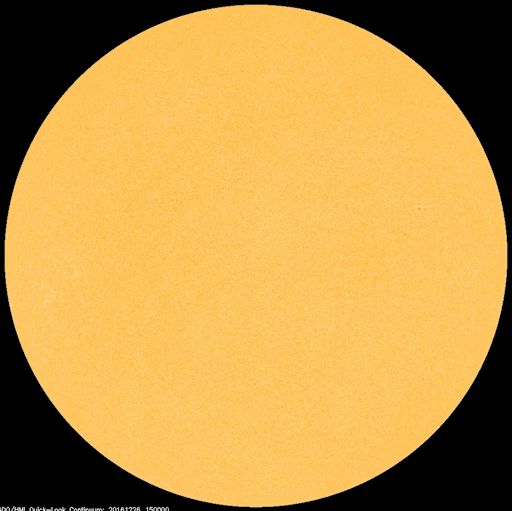
In total, 2016 has had 31 'spotless days'--a whole month's worth. We haven't had this many blank suns in a single year since 2010 (51 days). This is a sign that the sunspot cycle is crashing toward a new Solar Minimum.
There are many misconceptions about Solar Minimum. One holds that auroras vanish when sunspots disappear. Christmas Day 2016 was proof that the opposite is true. Without a hint of a sunspot on the solar disk, intense auroras raged around the Arctic Circle on Dec. 25th. What caused the luminous outburst? An enormous hole in the sun's atmosphere directed a stream of solar wind toward Earth, sparking a week-long display that is still underway. Such atmospheric holes are common during Solar Minimum, which is a fine time to see Arctic auroras.
Many people think space weather becomes dull or stops altogether during Solar Minimum. In fact, space weather changes in interesting ways. For instance, as the extreme ultraviolet output of the sun decreases, the upper atmosphere of Earth cools and collapses. This allows space junk to accumulate around our planet. Also, the heliosphere shrinks, bringing interstellar space closer to Earth; galactic cosmic rays penetrate our atmosphere with relative ease. Yes, Solar Minimum is coming ... but it won't be dull.
Realtime Space Weather Photo Gallery
Realtime Airglow Photo Gallery