EXITING THE SOLAR WIND STREAM: After six days inside, Earth is finally beginning to exit a broad stream of solar wind blowing from a large hole in the sun's atmosphere. Arctic sky watchers should remain alert for auroras, however, because wind speeds are still above 500 km/s. Free: Aurora Alerts.

I'M DREAMING OF A ... PINK CHRISTMAS? Christmas Day 2016 brought a fantastic display of auroras to the Arctic Circle. A great many of them were pink. James Helmericks sends this picture from the Colville River Delta in northern Alaska:
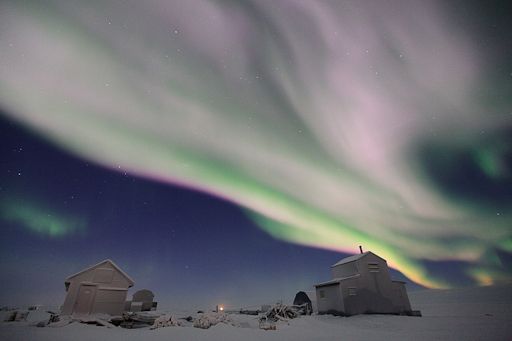
"This was the brightest pink display I have ever seen, at one time even giving the snow a pink tinge," he says.
The pink color is probably a sign of nitrogen. Most auroras are green--a verdant glow caused by energetic particles from space hitting oxygen atoms 100 km to 300 km above Earth's surface. Seldom-seen pink appears when the energetic particles descend lower than usual, striking nitrogen molecules at the 100 km level and below.
On the days and nights around Christmas 2016, the pinks became so intense, they appeared white, not only to cameras, "but also to the naked eye," says Sarah Skinner, who witnessed the strange colors several nights in a row from Abisko, Sweden. "It looked like someone had photoshopped the sky!" she says.
It is worth noting that these remarkable auroras appeared during a lull in solar activity. For three days centered on Christmas, the face of the sun was completely blank. There were no sunspots, no solar flares, and no CMEs. Instead, the display was caused by a high-speed solar wind stream blowing out of a large hole in the sun's atmosphere. Such atmospheric holes are common during Solar Minimum, so we can expect many similar displays as the sunspot cycle crashes in the years ahead.
IRIDESCENT CLOUDS OVER FRANCE: To see fantastic colors in the sky, it is not always necessary to travel to the Arctic Circle. Today, Dec. 27th, Antoine Gerhardt photographed this display over Serres, France:

"Such beautiful colors in the southern French sky," says Gerhardt.
These are iridescent clouds, colored by sunlight shining through tiny droplets of water. Many clouds contain water droplets, but only a few exhibit this kind of splendid iridescence. For such vivid pastel colors to appear, all of the droplets in the cloud must be of a uniform small size. Only then can the physics of diffraction work its color-creating magic.
Realtime Space Weather Photo Gallery
EVOLUTION OF A CORONAL HOLE: Christmas 2016 was special for sky watchers around the Arctic Circle. The skies were filled with some of the best and most colorful Northern Lights of the year. The source of the display: A giant "coronal hole" in the sun's atmosphere sprayed our planet with solar wind. The hole opened up in July 2016 and it has been strobing Earth with solar wind every ~28 days ever since as the hole spins around with the slowly turning sun.
Spaceweather.com reader Stuart Green has prepared a plot showing the evolution of the coronal hole and the effect it has had on the magnetic field at his private observatory in Preston, England. Click on the image to inspect the full 6 months:

Inset images come from NASA's Solar Dynamics Observatory. The coronal hole is the giant dark region, starting small in July, then growing and shape-shifting as the year unfolds.
The background strip chart recording shows the instability of the magnetic field around Green's private observatory. When the coronal hole is facing Earth, big changes are measured.
"I've been recording geomagnetic activity over the past three years using a home built/ home designed magnetometer," says Green. "The sensor is buried in my garden about 0.5m below the surface in an East/West orientation to allow very sensitive (sub nanotesla) measurements of magnetic declination occurring during geomagnetic storms. The plots show the change in magnetic flux density in nanotesla occurring between readings, which are taken automatically using logging software every 2.5 minutes."
Green's presentation suggests that this yawning hole is a long-lived feature on the sun, and it will probably be back as potent as ever 28 days from now. Stay tuned for magnetic unrest--and more Arctic auroras--in January.Realtime Airglow Photo Gallery