QUADRANTID METEOR SHOWER: On Tuesday of this week, Earth will pass through a stream of dusty debris from shattered comet 2003 EH1, source of the annual Quadrantid meteor shower. Forecasters expect the shower to peak around 14:00 UT (6 am PST) on Jan. 3rd--timing that favors western parts of North America and islands across the Pacific. As many as 100 meteors per hour could flow from a radiant near the North Star on Tuesday morning.

FIRST AURORAS OF THE NEW YEAR: A solar wind stream hit Earth's magnetic field on New Year's Eve, igniting a beautiful display of auroras to kick off the New Year. "Last night's aurora display was unbelievable," reports Sarah Skinner of Lights over Lapland in Abisko, Sweden. "This is literally as it came out of the camera....yes it REALLY was that bright!!!"

"Thank you clouds for clearing just in time for the peak of the show," she says. "Happy New Year for sure!"
Another, more potent solar wind stream is heading for Earth. Estimated time of arrival: Jan. 4th or 5th. Arctic sky watchers should prepare for a new round of Northern Lights as well as G1-class geomagnetic storms when the solar wind arrives. Free: Aurora Alerts.

POLAR STRATOSPHERIC CLOUDS: Earth's stratosphere is normally free of clouds. Not this weekend, though. Observers around the Arctic Circle are reporting an outbreak of brilliantly-colored icy clouds in the typically dry and transparent layer of our planet's atmosphere. Eric Fokke photographed the display on New Years Eve from the Lofoten Islands of Norway:
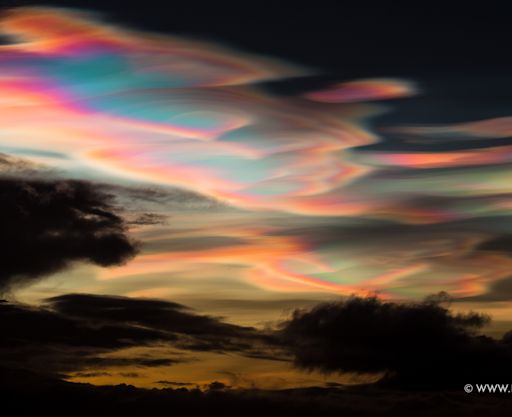
These icy clouds are a sign of very cold temperatures. For ice crystals to form in the arid stratosphere, temperatures must drop to around -85º C. High-altitude sunlight shining through tiny ice particles ~10µm across produce the characteristic bright iridescent colors.
Once thought to be mere curiosities, some polar stratospheric clouds (PSCs) are now known to be associated with the destruction of ozone. Indeed, an ozone hole formed over the UK in Feb. 2016 following an outbreak of ozone-destroying Type 1 PSCs.
These clouds really are as amazing as they look in Fokke's photo. They have much more vivid colors than ordinary iridescent clouds, which form closer to Earth in the troposphere. Once seen, a stratospheric cloud is never forgotten.
Browse the gallery for more sightings as polar winter unfolds:
Realtime Space Weather Photo Gallery
Realtime Airglow Photo Gallery