QUADRANTID METEOR SHOWER: On Tuesday of this week, Earth will pass through a stream of dusty debris from shattered comet 2003 EH1, source of the annual Quadrantid meteor shower. Forecasters expect the shower to peak around 14:00 UT (6 am PST) on Jan. 3rd--timing that favors western parts of North America and islands across the Pacific. As many as 100 meteors per hour could flow from a radiant near the North Star on Tuesday morning.

A LARGE HOLE IN THE SUN'S ATMOSPHERE: Stretching more than halfway across the face of the sun, a large hole in the sun's atmosphere is turning toward Earth. NASA's Solar Dynamics Observatory photographed the yawning structure on Jan. 2nd:

This is a "coronal hole"--a region in the sun's atmosphere where the magnetic field has opened up, allowing solar wind to escape. A stream of solar wind flowing from this coronal hole could reach Earth as early as Jan. 4th (Jan. 5th is more likely), sparking G1-class geomagnetic storms. Polar sky watchers should be alert for auroras later this week. Free: Aurora Alerts.

ANALEMMA TIMES 9: If you took a picture of the sun at the same time each day, would it remain in the same position? The answer is no, and the figure-8 shape traced out by the sun over the course of a year is called an "analemma." Over the years, many photographers have created analemmas. In 2016, however, Steven Riegel of Colorado Springs CO took it up a notch. He photographed the sun 9 times a day, creating the rare nonalemma:
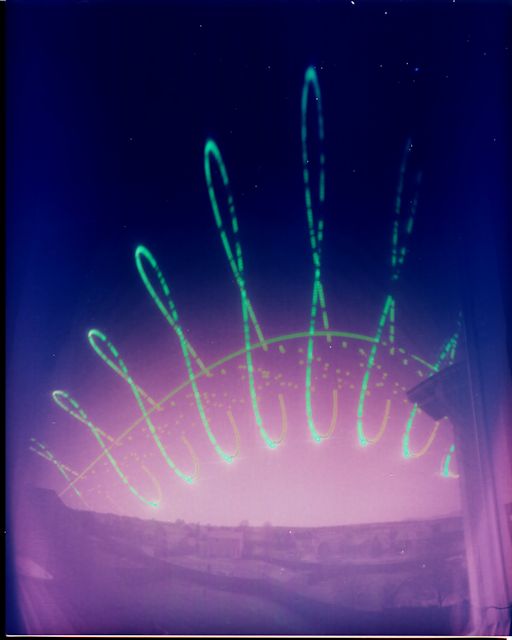
"I opened up a year-long (1 Jan - 31 Dec 2016) analemma exposure on New Year's Day," explains Riegel. " The result is a record of the position of the sun on the hour between 7:00 am and 3:00 pm every day for a full year."
"The camera is just a light-tight box with a pinhole in the side. I put an 8x10 piece of B/W photo paper inside. The pinhole was uncovered for two minutes each hour by a rotating paper mask attached to a cheap electric clock. The image is burned into the photo paper by the bright sunlight."
" I can't claim originality for the technique, but I've only seen a couple of other similar examples done previously," says Riegel. "It's a nerve-wracking time waiting for the year to see if you set things up correctly!"
Realtime Space Weather Photo Gallery
POLAR STRATOSPHERIC CLOUDS: Earth's stratosphere is normally free of clouds. Not this weekend, though. Observers around the Arctic Circle are reporting an outbreak of brilliantly-colored icy clouds in the typically dry and transparent layer of our planet's atmosphere. Eric Fokke photographed the display on New Years Eve from the Lofoten Islands of Norway:

These icy clouds are a sign of very cold temperatures. For ice crystals to form in the arid stratosphere, temperatures must drop to around -85º C. High-altitude sunlight shining through tiny ice particles ~10µm across produce the characteristic bright iridescent colors.
Once thought to be mere curiosities, some polar stratospheric clouds (PSCs) are now known to be associated with the destruction of ozone. Indeed, an ozone hole formed over the UK in Feb. 2016 following an outbreak of ozone-destroying Type 1 PSCs.
These clouds really are as amazing as they look in Fokke's photo. They have much more vivid colors than ordinary iridescent clouds, which form closer to Earth in the troposphere. Once seen, a stratospheric cloud is never forgotten.
Browse the gallery for more sightings as polar winter unfolds:
Realtime Airglow Photo Gallery