SURROUNDED BY SOLAR WIND: Earth is now fully inside a stream of solar wind flowing from a large hole in the sun's atmosphere. As a result, NOAA forecasters say there is a 60% chance of polar geomagnetic storms on Jan. 6th. Arctic sky watchers should remain alert for auroras on Friday night. Free: Aurora Alerts

Last night in Scandinavia, solar wind gusts of 700+ km/s sparked bright green Northern Lights. Rayann Elzein sends this picture from Inari, Finland, some 350 km inside the Arctic Circle:

"What a night up here in the Finnish Lapland," says Elzein. "One glance at the sky was enough to show that we are still inside the solar wind stream. It feels really good to be in the north when such a great show appears."
SUNSPOTS VANISH, SPACE WEATHER CONTINUES: As 2017 begins, one thing is clear. Sunspots are vanishing. So far, the sunspot number has been zero almost every day: Jan. 1st, 2nd, 4th, 5th, and 6th. A close look at today's sun reveals no dark cores at all:
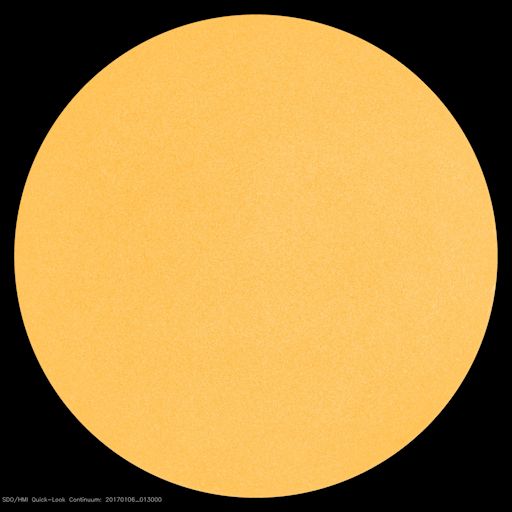
The increasingly-blank face of the sun is a herald of Solar Minimum. Sunspot numbers rise and fall with an ~11-year period, slowly oscillating between Solar Max and Solar Min. In 2017, the pendulum is swinging toward minimum.
Contrary to popular belief, space weather does not stop when sunspots vanish. The last few nights are proof: Auroras have been raging around the Arctic Circle. The cause of the display is a solar wind stream flowing from a large hole in the sun's atmosphere. Such "coronal holes" are common during solar minimum. No sunspots? No problem.
In fact, a lot of interesting things happen during solar minimum. For instance, as sunspots vanish, the extreme ultraviolet output of the sun decreases. This causes the upper atmosphere of Earth to cool and collapse. With less air "up there" to cause orbital decay, space junk accumulates around our planet.
Also during solar minimum, the heliosphere shrinks, bringing interstellar space closer to Earth. Galactic cosmic rays penetrate the inner solar system with relative ease. Indeed, a cosmic ray surge is already underway. Goodbye sunspots, hello deep-space radiation.
See? That blank sun is more interesting than it looks. Stay tuned for updates as the solar cycle changes.
FANTASTIC SUN PILLAR: When the air gets very cold, fantastic things can happen to the setting sun. Peter Rosén of Stockholm, Sweden, witnessed one of them on Jan. 5th. "With freezing temperatures, thermometers reading -10°C, and ice crystals floating in the air, we got a fantastic sun pillar at sunset this afternoon."

Sun pillars are caused by ice in the air. Plate-shaped crystals ice fluttering down from cirrus clouds catch the rays of the setting sun and spread it into a vertical column.
"Watch a leaf or piece of paper flutter and wobble as it falls," says atmospheric optics expert Les Cowley. "Ice crystals in the air wobble, too, and this smears the sun's reflection into a vertical line."
All around the world, the atmosphere is cold enough 5 to 10 km high to produce these ice crystals. That means sun pillars can be seen anywhere. However, the odds of sighting one improve in cold places like Sweden. Residents of the north should be alert for these beautiful pillars as winter unfolds.
Realtime Space Weather Photo Gallery
Realtime Airglow Photo Gallery