SOLAR WIND SPARKS ARCTIC AURORAS: This weekend, Earth is inside a stream of solar wind flowing from a large hole in the sun's atmosphere. This is causing bright auroras to dance around the Arctic Circle. Last night in Rovaniemi, Finland, photographer M-P Markkanen witnessed this astounding display:

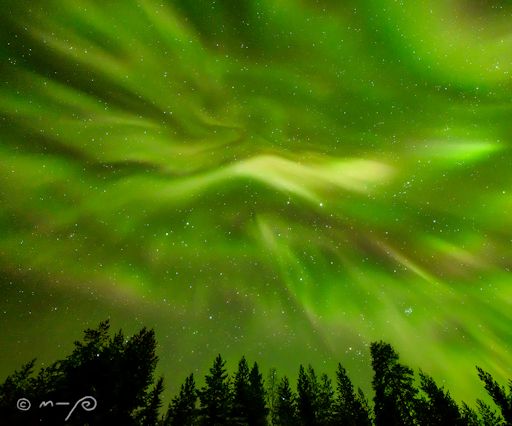
"I was driving home after midnight when, all of a sudden, I noticed in my rear mirror that the sky had just exploded into incredibly fast moving curtains of green, pink and white," says Markkanen. "I had to stop the car on the side of the road, and soon I got to witness the most incredible aurora show I've ever seen! It evolved into fast pulsing and flashing coronas that lasted for an hour or so. It looked like the whole sky was a big ember on a camp fire! Warmed me up a bit although I felt quite cold by then. It was just mind blowing."
Arctic sky watchers should remain alert for auroras on Saturday night as the solar wind continues to blow. Free: Aurora Alerts
LIGHT PILLARS OVER LATVIA: This morning in Riga, Latvia, photographer Ivo Dinsbergs stepped outside for a wakening breath of brisk winter air. The predawn sky was not peppered with stars, but instead subdivided by vertical columns of light:
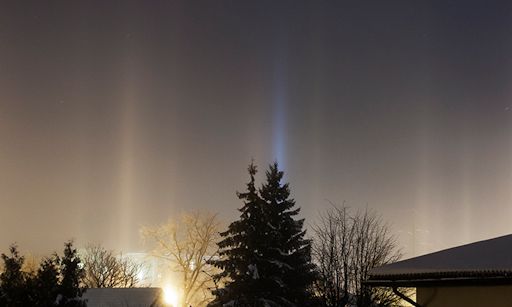
These are light pillars, caused by ice crystals in the air which intercept urban lights and spread them into colorful columns. The key ingredients of this phenomenon are ice and light pollution.
"Each pillar was rising directly above an unshielded street light," says Dinsbergs. Intrigued, he decided to collect some crystals from the air and photograph them:
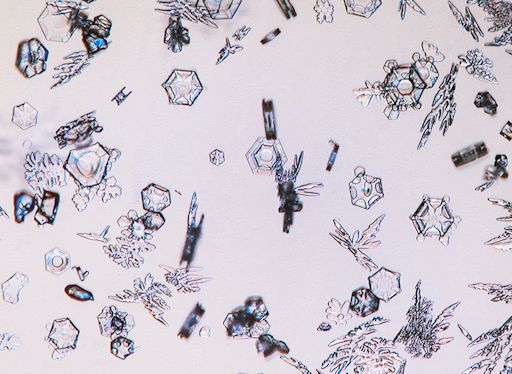
"Most of them were hexagonal plates," he notes.
That's to be expected. Flat six-sided ice crystals are perfectly shaped for making light pillars. The crystals flutter down from low-hanging clouds with their wide flat faces nearly parallel to the ground, much like a leaf falling from a tree. In this way they form an array of mirrors, reflecting street lights up and down, pillar-style.
Light pillars are a common sight in northern towns during winter. Look for more in the realtime photo gallery:
Realtime Space Weather Photo Gallery
SUNSPOTS VANISH, SPACE WEATHER CONTINUES: As 2017 begins, one thing is clear. Sunspots are vanishing. So far, the sunspot number has been zero almost every day: Jan. 1st, 2nd, 4th, 5th, 6th and 7th. A close look at today's sun reveals no dark cores at all:
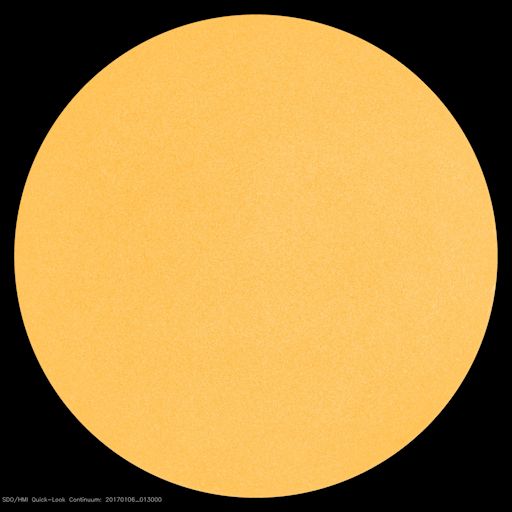
The increasingly-blank face of the sun is a herald of Solar Minimum. Sunspot numbers rise and fall with an ~11-year period, slowly oscillating between Solar Max and Solar Min. In 2017, the pendulum is swinging toward minimum.
Contrary to popular belief, space weather does not stop when sunspots vanish. The last few nights are proof: Auroras have been raging around the Arctic Circle. The cause of the display is a solar wind stream flowing from a large hole in the sun's atmosphere. Such "coronal holes" are common during solar minimum. No sunspots? No problem.
In fact, a lot of interesting things happen during solar minimum. For instance, as sunspots vanish, the extreme ultraviolet output of the sun decreases. This causes the upper atmosphere of Earth to cool and collapse. With less air "up there" to cause orbital decay, space junk accumulates around our planet.
Also during solar minimum, the heliosphere shrinks, bringing interstellar space closer to Earth. Galactic cosmic rays penetrate the inner solar system with relative ease. Indeed, a cosmic ray surge is already underway. Goodbye sunspots, hello deep-space radiation.
See? That blank sun is more interesting than it looks. Stay tuned for updates as the solar cycle changes.
Realtime Airglow Photo Gallery